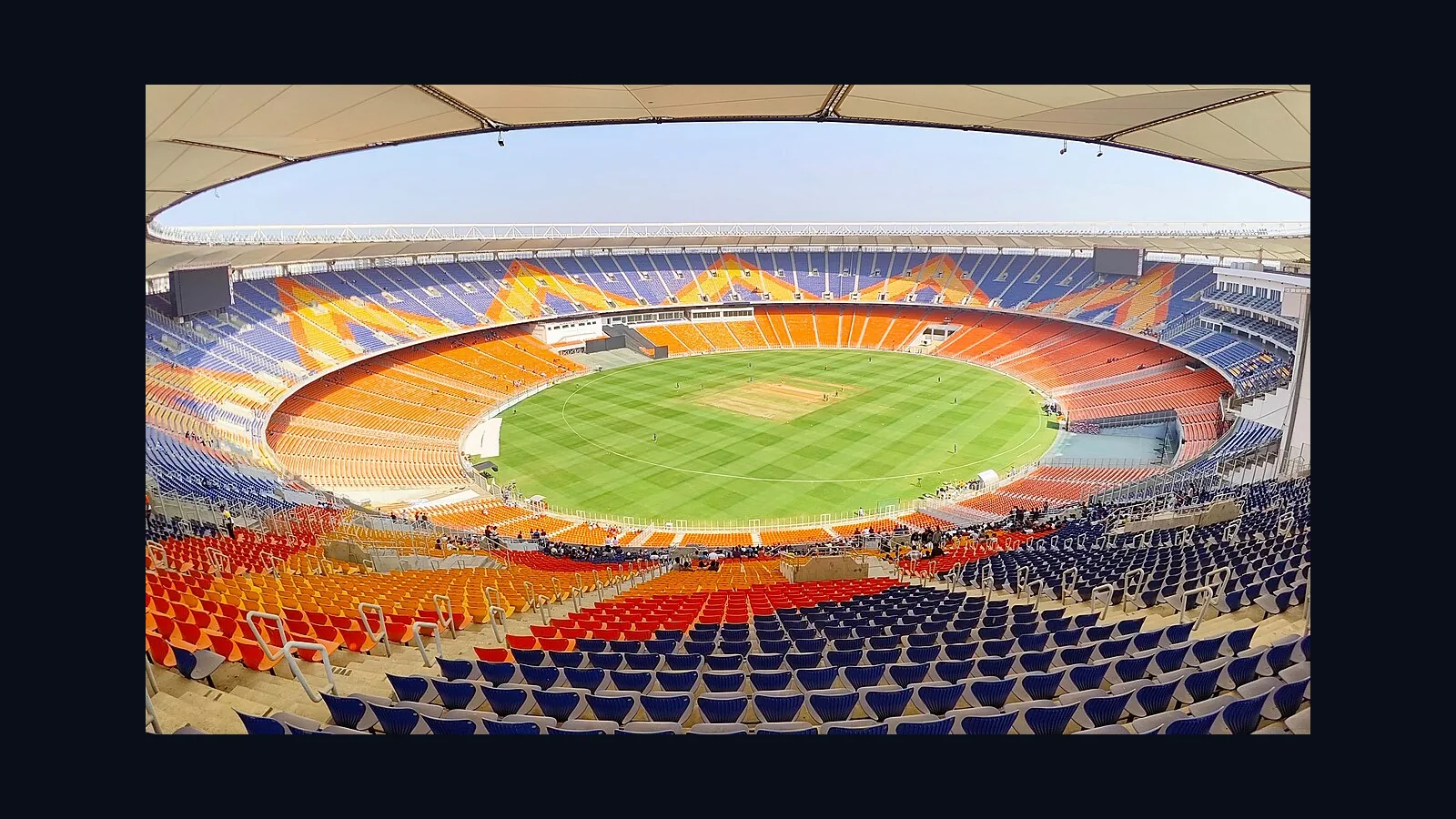
India’s largest cricket stadium is Narendra Modi Stadium in Ahmedabad, with a published capacity of 132,000. The Gujarat Cricket Association rebuilt the former Motera ground as a cricket-first venue, and both the BCCI and ICC identify it as a 132,000-seat stadium. That puts it well ahead of Eden Gardens in Kolkata, the next largest established venue in the evidence reviewed.
This ranking treats “largest” as published spectator capacity for a cricket-capable ground. It is not a ranking by land area, boundary length, roof size or a one-off attendance record. Capacity figures are not perfectly standardised: one source may count every fixed seat, another may include hospitality areas, while a multi-sport venue may publish a larger general-event figure than the number normally configured for cricket. The order below therefore gives a firm answer at the top and uses careful qualifications where the public numbers are close.
Key Takeaways
- Narendra Modi Stadium, Ahmedabad, leads India at 132,000 seats on the BCCI and ICC venue descriptions.
- Eden Gardens is second on the current published list at 68,000, while a proposed redevelopment would raise its planned capacity to 85,000; that expansion is not counted as present capacity.
- Raipur’s Shaheed Veer Narayan Singh International Cricket Stadium is about 60,000, making it a credible third-place venue, although its public capacity is usually presented as approximate.
- Ekana Cricket Stadium and Greenfield International Stadium sit around 50,000, with small differences caused by source methodology and multi-sport configuration.
- No single public census uses one identical capacity definition for every Indian ground, so lower positions should be read as an evidence-led comparison rather than a certified national register.
How “largest cricket stadium” is measured in India
The useful question for a fan is how many spectators a venue is built and configured to admit for cricket. That means published seating capacity is the primary measure here. A maximum crowd reported at a particular match can include standing areas, temporary arrangements, complimentary allocations or operational changes, so it is not automatically the same as the stadium’s fixed-seat capacity.
The BCCI’s venue directory is the main comparison source because it lists capacities for many international grounds in one format. It records 132,000 for Narendra Modi Stadium, 68,000 for Eden Gardens, 50,100 for Ekana, 50,000 for Greenfield and 46,000 for Barsapara. For Raipur, ESPNcricinfo’s ground record gives approximately 60,000, while The Indian Express describes it as India’s third-largest stadium by seating capacity. That combination is strong enough to include Raipur, but the “approximately” label should stay attached to the number.
The list does not count a proposed future capacity as though construction were complete. It also does not mix a football-only or rugby-only arena into a cricket list. For a wider directory of grounds and venue context, see CricWin24’s Cricket Grounds Directory.
Five major Indian cricket stadiums compared by capacity
1. Narendra Modi Stadium, Ahmedabad — 132,000
Capacity callout: 132,000 spectators
Capacity basis: published current spectator/seating capacity for a cricket stadium
Narendra Modi Stadium is the clear answer to “what is the largest cricket stadium in India?” The BCCI venue directory lists a capacity of 1,32,000, and the ICC’s venue profile calls it a 132,000-seat stadium. The ground is owned by the Gujarat Cricket Association and is used for Tests, ODIs, T20Is, first-class cricket, List A cricket, T20 matches and IPL fixtures.
That breadth matters. This is not a large general-purpose arena that happens to host an occasional cricket exhibition. It is a rebuilt cricket venue with permanent stands, cricket ends, floodlights and facilities designed around high-level matches. The Gujarat Cricket Association says the redevelopment was completed in February 2020 and that the reconstructed stadium can accommodate more than 1.3 lakh cricket fans. The BCCI uses the more precise 132,000 figure for its venue listing, so that is the number used in this ranking.
Older descriptions of Motera can create confusion because the former stadium had a much smaller capacity. The GCA says the pre-rebuild ground housed 49,000 cricket fans. That historical figure is not a second stadium: it is the earlier configuration of the same site. Motera and Narendra Modi Stadium must not be counted separately.
2. Eden Gardens, Kolkata — 68,000 current published capacity
Capacity callout: 68,000 on the BCCI venue listing
Capacity basis: published current venue capacity; tournament seating can be lower depending on allocation
Eden Gardens remains India’s second-largest established cricket venue on the BCCI’s current directory, which lists 68,000 seats. The Cricket Association of Bengal operates the historic Kolkata ground, and it remains a regular venue for international cricket and Indian Premier League matches.
There is an important qualification behind the number. Sportstar reported ahead of the 2023 ODI World Cup that the stadium’s tournament arrangement had 65,500 places, including 63,252 spectator seats and the balance in hospitality. That is an event-specific configuration, not proof that the venue’s broader published capacity is only 65,500. It does show why capacity figures can differ without one source necessarily being wrong.
There is also a future-project issue. Stadium designer Populous describes a CAB redevelopment that would increase Eden Gardens from 68,000 to 85,000 seats, with additional hospitality and spectator options. The project page describes the new chapter as a redevelopment plan, and its year is listed as to be confirmed. This article therefore ranks Eden on the present 68,000 figure, not the proposed 85,000. If the expansion is completed and becomes the operating capacity, the ranking should be revisited.
3. Shaheed Veer Narayan Singh International Cricket Stadium, Raipur — about 60,000
Capacity callout: approximately 60,000
Capacity basis: ESPNcricinfo ground record; seating-capacity position corroborated by current reporting
Raipur’s Shaheed Veer Narayan Singh International Cricket Stadium is the strongest challenge to any list that jumps directly from Eden Gardens to the 50,000-seat class. ESPNcricinfo lists the ground at 60,000 approximately, and The Indian Express describes it as India’s third-largest cricket stadium in terms of seating capacity.
The venue is in Naya Raipur, Chhattisgarh, and has hosted IPL matches, an ODI, an international T20 and domestic cricket. That record makes it a legitimate cricket ground for this comparison, not merely a large sports complex with an occasional cricket booking.
The qualification is transparency. The public record does not offer the same precise, owner-published capacity line that the BCCI provides for Narendra Modi Stadium or Ekana. The Indian Express reported in November 2025 that the Chhattisgarh State Cricket Sangh had taken the stadium on a 30-year lease and planned upgrades, including a better seating arrangement. That does not erase the existing approximately 60,000 description, but it means a future configuration could change the number.
Raipur therefore sits third with an approximate label rather than a falsely exact 60,000-seat claim. It is also why lists that call Greenfield or Ekana the third-largest should be read as using a different source set or omitting this venue, not as proof that Raipur is not cricket-capable.
4. Bharat Ratna Shri Atal Bihari Vajpayee Ekana Cricket Stadium, Lucknow — 50,000 to 50,100
Capacity callout: 50,100 in the BCCI directory; 50,000 in the ICC venue profile
Capacity basis: published fixed seating capacity for an international cricket stadium
Ekana is one of India’s modern cricket-first venues and sits fourth within this selected five-ground comparison. The BCCI directory lists 50,100, while the ICC’s venue profile rounds the figure to 50,000 and describes the Lucknow ground as the fifth-largest international cricket stadium in India in that source’s comparison.
The 100-seat difference is not meaningful for a national ranking. It reflects rounding or a different count of seats and hospitality spaces, not a material gap between two stadiums. The cleanest wording is “about 50,000,” with the exact source basis kept beside it.
The ground is home to the Uttar Pradesh cricket team and Lucknow Super Giants, and it has hosted international and franchise matches. That regular cricket use is important because the question is about cricket stadiums, not every large venue in India. Ekana’s capacity is also useful context for the Ekana Cricket Stadium, Lucknow venue guide, which covers the ground from a fan and match perspective.
Ekana should not be promoted above Raipur merely because its BCCI number is more precise. Precision of publication and size of capacity are different questions. The evidence supports a lower but more tightly specified 50,000–50,100 range.
5. Greenfield International Stadium, Thiruvananthapuram — about 50,000 for the current comparison
Capacity callout: 50,000 in the BCCI venue directory; older KCA material says 55,000
Capacity basis: current BCCI cricket-venue listing, with a multi-sport capacity discrepancy noted
Greenfield International Stadium in Thiruvananthapuram completes this five-venue set, but its rank is approximate because the public figures are configuration-dependent. The BCCI lists the venue at 50,000 and identifies it as a Kerala Cricket Association ground with cricket ends and floodlights. The KCA’s older 2016 announcement, written when it was arranging cricket use of the Sports Hub, called the stadium a 55,000-capacity venue.
Those numbers should not be silently blended. Greenfield is a multi-sport complex that was built for the National Games and includes facilities beyond cricket. The older KCA figure is a general stadium-capacity description connected to the Sports Hub, while the BCCI figure is the cleaner current comparison for an international cricket venue. This article therefore uses 50,000, while preserving the 55,000 figure as a documented discrepancy rather than presenting it as a verified cricket-only seat count.
Greenfield has hosted international cricket and remains a major cricket venue in Kerala. Its place beside Ekana is effectively a tie at the scale of a national list: both are around 50,000, and the order can change if an operator publishes a new cricket-specific seating plan. For related Indian venue context, the BCCI-linked ground directory and CricWin24’s Hyderabad stadium guide show how established venues can have materially smaller published capacities without being less important cricket grounds.
Other familiar grounds and the limits of this comparison
This is a selected five-ground comparison, not an exhaustive claim that no other Indian venue can share or exceed its lower positions. The BCCI directory provides useful additional capacity benchmarks. Barsapara Cricket Stadium in Guwahati is listed at 46,000, while Barabati Stadium is listed at 45,000. The MCA International Stadium in Pune is listed at 42,700. Rajiv Gandhi International Stadium in Hyderabad is listed at 39,200, and M.A. Chidambaram Stadium in Chennai at 38,200. M. Chinnaswamy Stadium and Wankhede Stadium are listed at 33,800 and 33,100 respectively.
Barsapara is a legitimate cricket ground and is described by Rajasthan Royals as having more than 40,000 seats. Some secondary descriptions give higher or extendable figures, but the evidence reviewed did not establish a single current cricket-specific number that should displace the BCCI’s 46,000 listing. Likewise, a planned seating increase or a maximum event arrangement would not be counted as an operating fixed capacity until documented as complete.
A famous venue is not automatically a large venue: history and atmosphere are separate from spectator capacity. The Hyderabad ground has a lower capacity in the BCCI directory used for this comparison; see the Rajiv Gandhi International Stadium guide for venue context.
Frequently Asked Questions
Which is the largest cricket stadium in India?
Narendra Modi Stadium in Ahmedabad is the largest, with a published capacity of 132,000 spectators. The BCCI and ICC both use that figure for the rebuilt Gujarat Cricket Association venue.
Is Narendra Modi Stadium the same as Motera Stadium?
Yes. Motera was the former name and earlier configuration of the same Ahmedabad ground. The GCA says the old stadium held 49,000 before reconstruction; the rebuilt venue was renamed Narendra Modi Stadium and is listed at 132,000. Counting both as separate stadiums would double-count the site.
Is Eden Gardens’ capacity 68,000 or 65,500?
Both figures describe published but different bases. The BCCI lists 68,000 for the venue. Sportstar reported a 65,500-capacity tournament arrangement for the 2023 World Cup, including 63,252 spectator seats and hospitality places. For a current venue ranking, this article uses 68,000 and explains the event-specific lower configuration.
Will Eden Gardens become larger than Narendra Modi Stadium?
No completed change establishes that. Populous describes a proposed redevelopment that would take Eden Gardens from 68,000 to 85,000 seats. That planned capacity is not counted until the work is complete and the new configuration is operating. Even 85,000 would remain below Narendra Modi Stadium’s published 132,000.
Why is Raipur ranked above Ekana and Greenfield?
ESPNcricinfo lists Shaheed Veer Narayan Singh International Cricket Stadium at approximately 60,000, and The Indian Express calls it India’s third-largest by seating capacity. Ekana and Greenfield are around 50,000 on the stronger current comparison figures. Because Raipur’s number is approximate and its management planned upgrades, the wording stays qualified.
Are these official national rankings?
No. This is an evidence-led editorial ranking based on published spectator capacities for cricket-capable venues available on 22 October 2026. India does not have one public, consistently defined national census that reconciles fixed seats, hospitality, temporary capacity and multi-sport configurations for every ground.
Conclusion
The direct answer is stable: Narendra Modi Stadium in Ahmedabad is India’s largest cricket stadium at 132,000 published seats. Eden Gardens follows at 68,000 on the BCCI listing, while Raipur is a credible third at approximately 60,000. Ekana and Greenfield form a close 50,000-seat group, with Ekana listed at 50,100 by the BCCI and Greenfield affected by the difference between a current cricket-venue listing and an older general Sports Hub capacity.
For comparable country-by-country context, see the Cricket Insights hub and the relevant Australia stadium comparison when assessing how different venue configurations affect the word “largest.”
Cover: A Cricket Premi, 2023-07-28. Original photograph · CC BY-SA 4.0. The fitted WebP variants retain the same license; resizing, conversion and navy letterboxing only.
Source register
Selected capacity references are kept compact here. Venue operators and boards are named beside the figures in the article; general, cricket-specific and temporary capacities are distinguished. Archival image credits are separate from the capacity evidence.
View the consulted sources
Read our editorial standards or corrections process for factual updates.