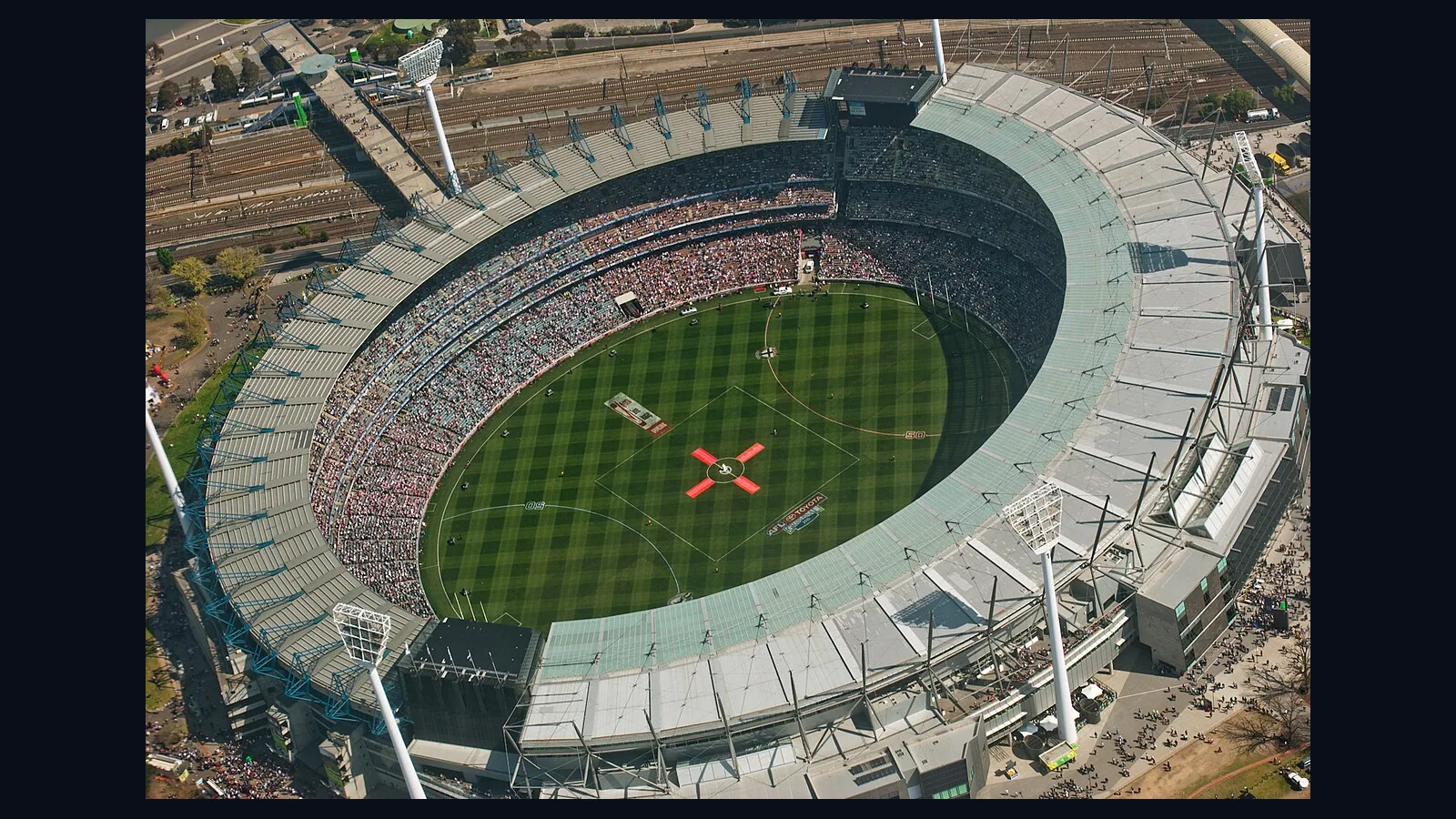
Australia's largest cricket stadium is the Melbourne Cricket Ground (MCG) in Melbourne, with a published total capacity of 100,024. The Melbourne Cricket Club describes that total as 95,000 seats plus approximately 5,000 standing-room places. It is comfortably ahead of every other cricket-capable venue in the country.
This ranking treats “largest” as spectator capacity for a venue that can host cricket. That is more useful than comparing boundary lengths, playing-area size or the amount of land around a ground. It also avoids a common mistake: quoting an AFL, concert or historical crowd number as if it were the normal cricket configuration. Where a venue publishes a different cricket arrangement, that number is shown separately.
Key Takeaways
- The MCG is Australia’s clear leader at 100,024 published total capacity, including about 95,000 seats and 5,000 standing places.
- Perth’s Optus Stadium is the next major cricket venue on the evidence available: its operator describes a 60,000-seat stadium and a cricket layout with seating for a minimum of 55,000.
- Adelaide Oval follows at 53,500 total capacity, including 3,500 standing places on the northern mound.
- The SCG and Marvel Stadium/Docklands Stadium form an approximate cricket-capacity tie at 48,000 below Adelaide Oval; the displayed order keeps SCG fourth and Marvel fifth without claiming an exact pairwise difference.
- The Gabba is sixth at 42,000 for its standard cricket and AFL season, although event overlays can change the number admitted.
- This is a capacity comparison, not a ranking of famous matches or record attendances. Proposed future expansions are not counted until they are operating venues with a published capacity.
How “largest cricket stadium” is measured in Australia
A stadium can have one headline capacity and several practical event capacities. Sight screens, hospitality holds, temporary seating, standing-room areas, broadcast compounds and safety plans can all change the number available for a particular match. For this guide, the primary figure is the venue owner or Cricket Australia’s published spectator capacity. The cricket-specific figure is used when the operator publishes one; otherwise the general operating capacity is labelled plainly rather than presented as a made-up cricket census.
That distinction matters most at multi-sport grounds. Optus Stadium is a legitimate cricket venue, not a football-only stadium: its operator says it hosts Test, limited-overs and Big Bash cricket and was designed to ICC requirements. Adelaide Oval, the SCG, Marvel Stadium and The Gabba are likewise established cricket venues with current domestic and/or international use. They belong in this comparison even though each also hosts other sports.
For readers comparing venues across countries, the same principle applies to the largest cricket stadium in India, largest cricket stadium in England and largest cricket stadium in New Zealand: compare like-for-like spectator configurations, not an arena’s biggest possible concert mode.
The six largest cricket-capable stadiums in Australia
The order below is firm at the top and approximate where published figures use different bases. A “total” may include standing room; a “minimum” is not an exact sellable count for every match. The SCG is shown fourth and Marvel fifth because both have a published cricket-specific figure of 48,000; that is an approximate same tier below Adelaide Oval, not an assertion that one has an exactly larger cricket inventory.
1. Melbourne Cricket Ground (MCG) — Melbourne, Victoria
Published capacity: 100,024 total
The MCG is the straightforward answer to the search question. Cricket Australia calls it Australia’s largest cricket ground, while the MCG’s own ticket information breaks the headline total into 95,000 seats and approximately 5,000 standing-room spaces. That makes the venue’s public capacity figure unusually transparent: it is not simply a rounded “100,000-plus” claim.
The MCG is also an active cricket venue, serving as the home ground for the Melbourne Stars and hosting international Tests, ODIs and T20Is. The entire 100,024 should still be read as a venue-wide published capacity rather than a promise that every match will sell exactly that many cricket tickets. Each sport and event has its own seating arrangement, and cricket sight screens and operational holds can affect the event manifest.
The difference between capacity and attendance is visible in the ground’s official history. The MCG records 94,199 as the largest single-day Test-cricket attendance, for the first day of the 2025 Boxing Day Test, and 93,013 as its record ODI attendance for the 2015 World Cup final. Those are maximum recorded crowds for particular cricket events, not a reason to replace the venue’s published capacity figure. Its 80,883 domestic-cricket record, set in the 2016 Big Bash, is a match attendance rather than a seating specification.
For match planning, the BBL overview and BBL venues guide are useful next steps. They add competition context without changing the MCG’s position in this capacity ranking.
2. Optus Stadium — Perth, Western Australia
Published capacity basis: 60,000 seats generally; minimum 55,000 in the documented cricket layout
Optus Stadium is the most important configuration-dependent entry. The operator describes a 60,000-seat multi-purpose stadium, but its cricket section says sight screens are positioned to maximise seating for a minimum of 55,000 fans. That is the defensible number to use for cricket comparison, while retaining the 60,000 general seating figure as context.
This is why Optus Stadium is ranked ahead of Adelaide Oval but not described as an exact 60,000-seat cricket sell-out in every match. The published cricket basis is a minimum, not a precise event-by-event inventory. The venue has five drop-in cricket wickets, 16 outdoor practice wickets, a cricket playing surface measuring 177 metres by 141 metres fence line to fence line, and facilities designed for Test and limited-overs cricket. It also hosts every Big Bash season in Perth.
The ground’s football and concert capacities should not be mixed into the cricket figure. The same official fact sheet gives a concert-mode maximum of 70,000, but that is an entertainment configuration and is irrelevant to this list. Likewise, a future or temporary seating addition would need a current event-specific announcement before it could replace the operator’s standing cricket basis.
Optus therefore sits in a narrow band with Adelaide Oval: the general stadium headline is larger, while the documented cricket arrangement is “at least 55,000.” Readers should treat the numerical gap as a capacity-basis difference, not as proof that every Optus cricket match admits precisely 1,500 more people than Adelaide Oval.
3. Adelaide Oval — Adelaide, South Australia
Published capacity: 53,500 total, including 3,500 standing places
Adelaide Oval’s official FAQ gives a total capacity of 53,500 and specifies that 3,500 of those places are standing room on the northern mound. In practical terms, that indicates about 50,000 seated places plus the standing area, although event-day ticketing can still alter the mix. Cricket Australia also lists the venue at 53,500 and describes its Test, ODI and Big Bash use.
That transparent standing-room note is important. A list that calls Adelaide Oval a 53,500-seat cricket stadium would overstate its fixed seating. The accurate description is 53,500 total capacity, with a documented 3,500 standing-room component. The venue remains one of Australia’s largest cricket-capable grounds because the full spectator provision is relevant to a fan deciding where a major match can be staged.
Adelaide Oval’s redevelopment made it a genuine multi-sport stadium without removing its cricket identity. It hosts South Australian cricket and international fixtures, and its wide oval layout supports both the field and the surrounding spectator bowl. The ground also illustrates why a single national order should be read with care: Optus publishes a cricket minimum, while Adelaide publishes a total that explicitly includes standing room.
If you are comparing ground layouts rather than national capacity, use the Cricket Grounds Directory for general stadium and pitch guides. Capacity is only one part of understanding a venue; sightlines, general-admission areas and event holds can matter more for a particular fixture.
4. Sydney Cricket Ground (SCG) — Sydney, New South Wales
Published capacity: 48,000
The SCG is listed by Cricket Australia at 48,000, and Venues NSW says the 2014 opening of the MA Noble, Don Bradman and Dally Messenger Stand increased capacity to that figure. It is an established cricket ground, the home of the Sydney Sixers in the Big Bash, and the venue for international cricket in Sydney.
Unlike the MCG and Adelaide Oval, the public capacity pages reviewed do not break the SCG number into fixed seats, standing room and cricket-only holds. The honest label is therefore “48,000 published capacity,” not “48,000 fixed cricket seats.” That keeps the SCG below Adelaide Oval on the published total while acknowledging that a specific Test, ODI or T20 event may have a different sellable inventory.
The SCG’s place in the list is secure against football-only confusion: it is named the Sydney Cricket Ground, hosts the Sydney Sixers and is used for international cricket. Its multi-sport history does not disqualify it. The relevant question is whether cricket can be staged there at the stated venue scale, and it can.
5. Marvel Stadium (Docklands Stadium) — Melbourne, Victoria
Published capacity basis: 53,343 general venue capacity; 48,000 cricket-specific profile
Marvel Stadium and Docklands Stadium are two names for the same Melbourne venue, not separate grounds. Cricket Australia identifies Marvel as the Melbourne Renegades’ BBL home and states a general capacity of 53,343. The ESPNcricinfo Cricket Grounds Directory gives the more specific profile “12,000 to 70,000 (Cricket: 48,000)”. This ranking therefore uses 48,000 for cricket and retains 53,343 as the venue-wide context.
That configuration distinction is why Marvel is not inserted above the SCG simply because its generic all-sport number is 53,343. A generic all-sport ordering could place Marvel differently, but this article compares cricket-capable venues on the most relevant published cricket basis. Marvel and the SCG consequently occupy an approximate same tier below Adelaide Oval; the requested display order keeps the SCG fourth and Marvel fifth, with no exact pair order claimed.
6. The Gabba — Brisbane, Queensland
Published capacity: 42,000 for the standard cricket and AFL season
The Gabba’s operator states that its official capacity is 42,000, with the number able to vary according to event overlays. Its FAQ specifically says the standard information applies to the cricket and AFL season, while concert mode can host up to 60,000 patrons. For a cricket ranking, 42,000 is the correct published basis; 60,000 is not.
The Brisbane venue is a current cricket ground and home to the Brisbane Heat and Queensland Bulls as well as hosting international cricket. The operator describes its cricket wicket as one of the venue’s defining features. That makes The Gabba an appropriate sixth entry even though its concert configuration is larger than its normal sporting capacity.
Because the operator warns that overlays can change capacity, 42,000 should not be read as a guaranteed number of tickets for every Test or Big Bash match. It is the venue’s official standard capacity and the best public comparison figure available here. A future rebuild, new stand or temporary event plan would not automatically change the ranking: it would need to be completed or specifically documented as an operating cricket configuration.
What the ranking does—and does not—claim
The MCG is the clear leader because both the venue and Cricket Australia publish a capacity just above 100,000, and the MCG remains an active cricket ground. The lower five are more nuanced. Optus has the largest general seating headline after the MCG but publishes a cricket minimum of 55,000. Adelaide’s 53,500 includes 3,500 standing places. The SCG publishes 48,000 without a public seat-by-seat cricket split, while Marvel’s general 53,343 is paired with an ESPNcricinfo cricket profile of 48,000. The SCG and Marvel are therefore an approximate same cricket-capacity tier below Adelaide, and The Gabba publishes 42,000 for standard cricket and AFL while acknowledging event-overlay variation.
Those differences make the lower order approximate rather than a certified national census. This guide does not use boundary length, land area, a one-off maximum concert mode or a historic crowd as a proxy for cricket capacity. It also excludes proposed expansions and venues that do not have sufficient current capacity evidence. The result is a useful, source-led answer for fans: the MCG is first by a wide margin, Optus and Adelaide form the next capacity tier, the SCG and Marvel follow on their published cricket figures, and The Gabba is sixth on its standard sporting capacity.
Frequently Asked Questions
What is the largest cricket stadium in Australia?
The Melbourne Cricket Ground in Melbourne is the largest, with a published total capacity of 100,024. The MCG’s ticket information says that total comprises 95,000 seats and approximately 5,000 standing-room places.
Is Optus Stadium bigger than Adelaide Oval for cricket?
On the published figures, Optus Stadium has the larger general stadium capacity at 60,000 seats, and its operator documents a cricket layout with seating for a minimum of 55,000. Adelaide Oval publishes 53,500 total capacity, including 3,500 standing places. Because the figures use different bases, the comparison is best described as Optus ahead on the documented cricket minimum, not as an exact match-by-match margin.
Why is Marvel Stadium listed separately from Docklands Stadium?
It is not a separate venue. Marvel Stadium and Docklands Stadium are aliases for the same Melbourne ground. Cricket Australia gives the venue-wide capacity as 53,343, while the ESPNcricinfo Cricket Grounds Directory profile states “12,000 to 70,000 (Cricket: 48,000).” The ranking uses the cricket-specific 48,000 figure, placing Marvel in an approximate tie with the SCG below Adelaide Oval rather than ordering it by the generic all-sport number.
Does the MCG’s 100,024 include standing room?
Yes. The MCG says its total capacity includes 95,000 seats and approximately 5,000 standing-room spaces. That is why this article calls 100,024 a total spectator capacity rather than 100,024 fixed seats.
Is The Gabba’s 60,000 capacity its cricket capacity?
No. The Gabba’s operator gives 42,000 as the official capacity and says the standard information applies to cricket and AFL. Up to 60,000 is a concert-mode figure, so it is not used for this cricket ranking.
Are historic cricket crowds the same as stadium capacity?
No. A historic attendance records how many people entered one event, while capacity describes the venue’s published spectator provision. For example, the MCG’s official history lists a 94,199 single-day Test attendance and a 93,013 ODI attendance, but the venue’s published capacity remains 100,024 total. The two measurements answer different questions.
Final answer
If you need one name, choose the Melbourne Cricket Ground: it is Australia’s largest cricket stadium by a wide margin, with a published total capacity of 100,024. Optus Stadium is next on the documented cricket configuration, followed by Adelaide Oval, the SCG, Marvel Stadium/Docklands Stadium and The Gabba. Marvel’s 53,343 is a general venue figure; its cricket-specific profile is 48,000, approximately tied with the SCG, so a generic all-sport ordering could differ. Read the lower ranks with their capacity basis attached, because standing room, sight screens and event overlays can change the number available for a particular match.
Cover: Alexander Sheko, 2010-10-02. Original photograph · CC BY-SA 2.0. The fitted WebP variants retain the same license; resizing, conversion and navy letterboxing only.
Source register
Selected capacity references are kept compact here. Venue operators and boards are named beside the figures in the article; general, cricket-specific and temporary capacities are distinguished. Archival image credits are separate from the capacity evidence.
View the consulted sources
Read our editorial standards or corrections process for factual updates.