WOMEN’S BIG BASH LEAGUE
WBBL Fixtures and Results
Complete official Weber WBBL|12 fixtures and results snapshot: all 40 regular-season matches, finals dates, venues, start times, status and source links.
Original equipment illustration · not a photograph of a player, named venue or WBBL matchSeason: Weber WBBL|12 · 2026–27 · Sources checked . Source-checked snapshot, not a live score feed.

WBBL fixtures and results.
Start times below use each venue’s local time zone. Finals with unconfirmed teams, grounds or times remain unassigned. Match status is the status recorded by the source, not a result inferred from today’s date.
No fixtures match these filters. Reset a filter to see more matches.
The Weber WBBL|12 fixture list is the practical starting point for following Australia’s women’s domestic T20 season. The official Cricket Australia schedule runs from Thursday 29 October to Saturday 5 December 2026. It contains 43 matches across 38 days: 40 regular-season games and a three-match finals series. 1 This page keeps the published schedule together with each match’s official match-centre link, so you can move from a date check to the latest available scorecard without treating an advertised fixture as a result.
How the season is arranged
The regular season finishes on Sunday 29 November with a double-header at Karen Rolton Oval. The finals then begin on Tuesday 1 December with The Knockout, continue with The Challenger on Thursday 3 December, and end with The Final on Saturday 5 December. The published finals format is qualification-based: the third- and fourth-ranked teams meet in The Knockout, its winner travels to meet the second-ranked qualifier in The Challenger, and the top regular-season team hosts the Final. 1 Until those standings are known, the participant fields on this page stay empty. That is more useful than displaying invented “Team A” or “Team B” labels that could be mistaken for confirmed finalists.
Every club has ten regular-season fixtures in the published 40-game home-and-away phase. The schedule also makes the competition’s travel pattern visible. Melbourne’s two clubs share Junction Oval, Sydney games are split between Drummoyne Oval and North Sydney Oval, and the other regular venues include Allan Border Field, Karen Rolton Oval, WACA Ground, Ninja Stadium and Adelaide Oval. 1 Venue context matters in WBBL because a club’s listed home team does not always mean the match is played in that club’s usual city. Match 10, for example, lists Adelaide Strikers as the home side but is scheduled at Drummoyne Oval in Sydney; match 39 lists Brisbane Heat as home at Karen Rolton Oval in Adelaide. Check the venue field before planning travel.
Reading a fixture on match day
Start with the date, then read the advertised time and the venue together. The official schedule graphic says all displayed times are AEDT. 3 This is the competition’s published reference clock, while the data here also supplies the venue’s IANA time zone and a venue-local conversion for practical use. Melbourne and Sydney observe Australian Eastern Daylight Time in these dates. Brisbane remains on Australian Eastern Standard Time, Adelaide is on daylight time, Perth is on Australian Western Standard Time, and Hobart follows daylight time. A Brisbane evening listing therefore starts earlier on a Brisbane clock than the same AEDT label suggests, and a Perth night listing is earlier again. Use the AEDT reference when comparing the official graphic; use the venue-local time shown in this table when you are physically at the ground.
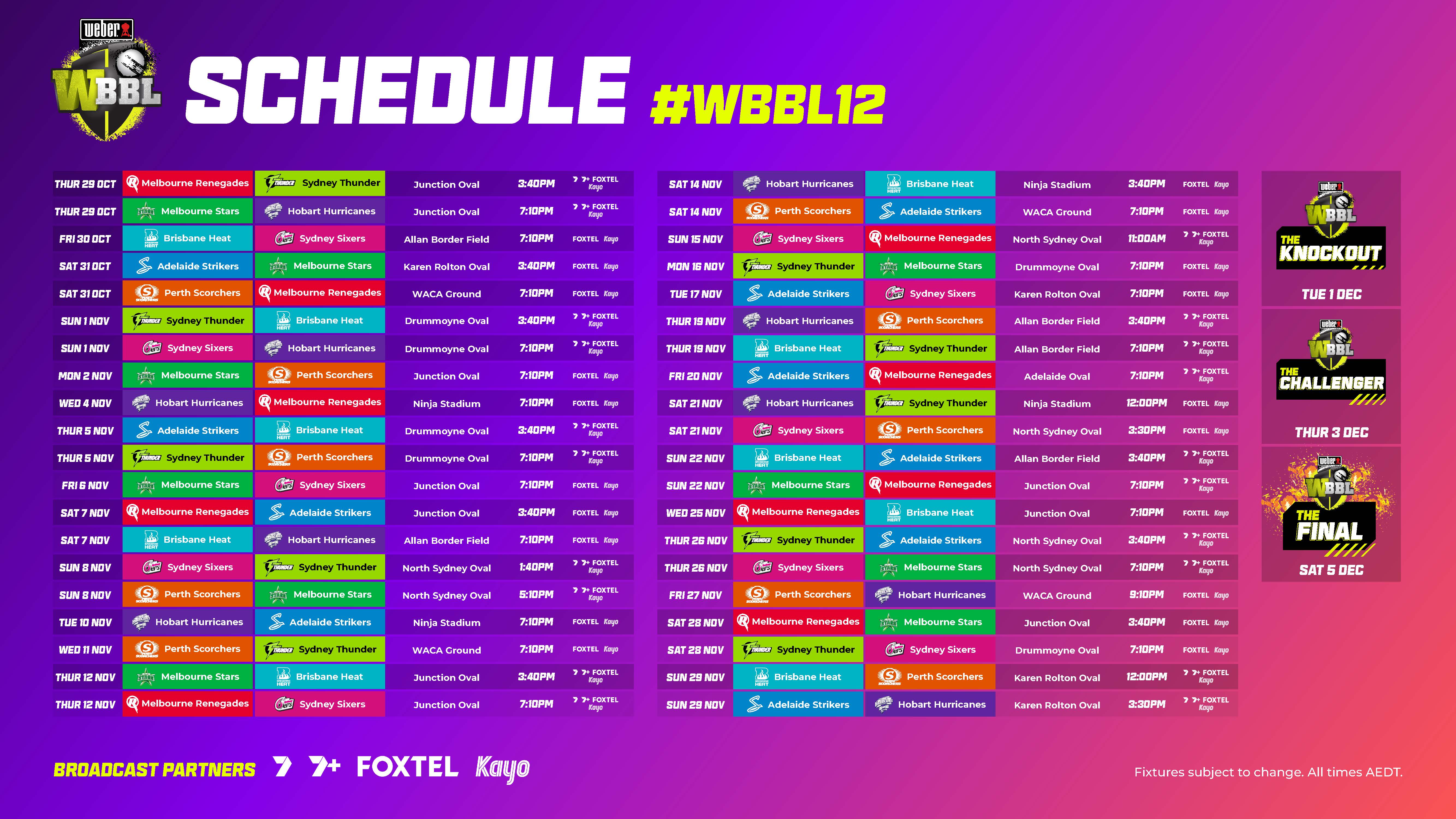
Double-headers need an extra check. The opening day has two matches at Junction Oval, while Drummoyne Oval hosts two games on 1 November and 5 November. North Sydney Oval also carries two matches on 8 November and 21 November. Allow for the first match to finish, a changeover, and venue entry rules rather than assuming a second game begins immediately after the first. The official match centre is the place to check broadcast links, ticket information and any late operational notice attached to a game. 2
For a quick scan, filter by team to see that club’s complete path through the regular season. Filter by venue to find double-headers or local home-ground runs. Filter by date when you are planning a weekend, and use the stage filter to separate the 40 regular games from the three finals slots. The Upcoming label means Cricket Australia had published the fixture as a future match at the time checked. It does not mean a team has won, a toss has happened, or a result is available. Once an official result is posted, the result and score fields can replace the pre-match state without changing the match identity.
Statuses, results and changes
This schedule deliberately separates a source status from a guessed live state. The official regular-season match centres reported “Teams will be announced at the toss” in their event status at retrieval, while the series listing labelled the fixtures Upcoming. 2 No score, toss decision or result is filled until Cricket Australia publishes one. The time is also not calculated from “now”: it is copied from the official UTC start value exposed by the match centre. That distinction prevents a page refresh from turning a postponed match into a false live match or a future match into a completed one.
Fixtures can move. The official schedule graphic itself warns that fixtures are subject to change. 3 A replacement snapshot should therefore recheck the date, UTC start, venue, teams, status, result and finals information rather than only adding new rows. If a match is rescheduled, retain its official match-centre ID and URL so readers do not lose the history of the fixture. If a venue or time changes, show the newly published value and make the official source the authority. If a final qualifier or host is not yet published, leave it unknown. This page is a checked schedule snapshot, not a promise of autonomous live updating.
Planning around the WBBL window
The compact 38-day calendar rewards readers who plan by blocks rather than by isolated games. Opening week places matches in Melbourne, Brisbane, Adelaide, Perth and Sydney before the schedule settles into longer runs at shared venues. That can help supporters follow a club’s rhythm, but it can also hide a travel issue when a home-labelled team appears in a neutral or relocated setting. Treat the venue as the ground truth for attendance, and treat the home and away labels as the competition’s fixture designation. They answer different questions.
The late-November run is especially useful for a calendar view. Several dates carry evening matches after an afternoon game, while the final regular-season double-header on 29 November sets up the standings that determine the finals path. A fan tracking qualification should therefore check the standings separately from this schedule. This page can tell you which finals slot is published and when it is dated; it cannot fill a qualifier before the official competition record does. That separation keeps the fixture list useful for planning without turning it into a prediction or an unofficial ladder.
For the wider competition overview, use the WBBL landing page. The separate BBL page is not a substitute for this women’s competition schedule: WBBL|12 has its own dates, venues, finals path and match-centre records. Readers looking for a prediction should treat it as a different kind of page from this fixture list; a schedule confirms what is published, not what will happen on the field.
Continue following the WBBL
Sources and update notes
Datasets are checked snapshots, loaded by the server from one season-specific source file. No live score provider or automatic results refresh is connected. Later fixtures, results and standings require a validated source update; consult the official match centre for changes.