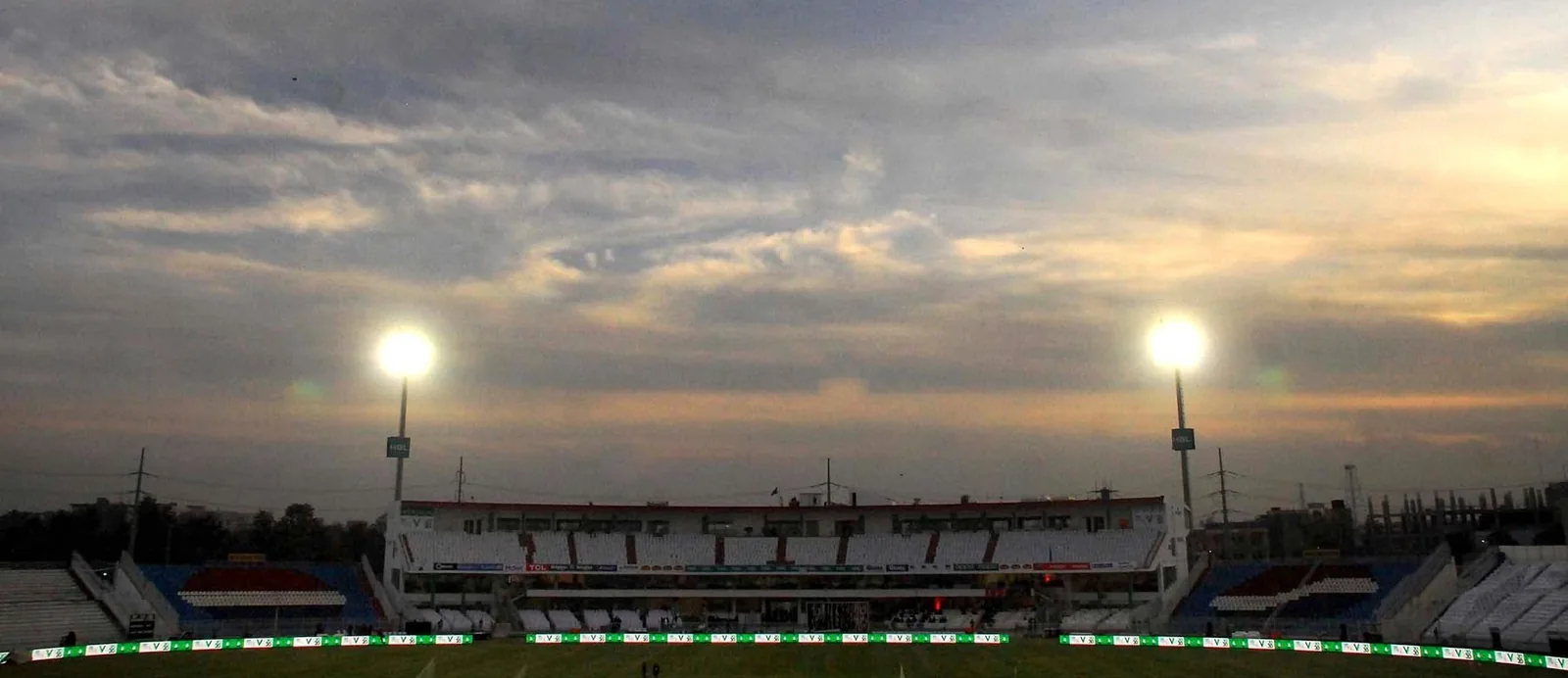
Rawalpindi Cricket Stadium is a versatile Pakistan venue, not a one-line “flat track” or “turner”. The clearest reading of the evidence is conditional: the ground produced huge, low-event Test totals in 2022, then hosted markedly more spin-influenced Tests in 2024. Its white-ball record also runs from a 337/3 ODI chase to a 90 all out and a rain-shortened no-result T20I. For a current venue reference, see the Pakistan cricket grounds guide.
This guide is checked to 22 October 2026. It covers men’s TEST, ODI and T20I cricket only. PSL, domestic, women’s and age-group matches are not merged into the international record discussion.
Key takeaways - Treat Rawalpindi as preparation- and weather-dependent. A 2022 Test was exceptionally high-scoring; two Tests in 2024 were far more result-bearing and spin-influenced. - The best verified ODI batting example here is Pakistan’s 337/3 chase of New Zealand’s 336/5 on 29 April 2023, with Fakhar Zaman making 180 not out. - T20I evidence is mixed: rain ended the first Pakistan–New Zealand match after two balls in April 2024, while the next two produced a 90 all out and a successful 179/3 chase. - The older ESPNcricinfo profile lists 15,000 seats; ICC’s 2025 Champions Trophy release calls the stadium 20,000-capacity. Use the label with its source and date rather than treating capacity as immutable. - Sri Lanka v England was scheduled at Rawalpindi for 22 October 2026. No result is included here without a verified completed scorecard.
Venue identity and capacity
The stadium is in Rawalpindi, Punjab, close to Islamabad, and is the home venue associated with Pakistan and Rawalpindi cricket. ESPNcricinfo’s ground profile records its establishment as 19 January 1992, lists Pavilion End and Shell End, and identifies a grass pitch. The profile’s historical description says the newly built ground had seating for 15,000.
Capacity is best treated as a dated operational label. The ICC’s 19 February 2025 host-city release described Rawalpindi Cricket Stadium as a 20,000-capacity venue for the Champions Trophy. PCB’s January 2025 upgrade update separately said that 10,000 new chairs, hospitality-box work and two replay screens were being installed, without publishing a revised total. That is why this page records both credible figures instead of presenting a single unsupported “official capacity”. Match-day seating can also differ from a venue profile because of segregation, media areas and temporary operations.
The ground’s international history is broad enough to make simplistic pitch typing risky. It has staged long-form cricket, day-night ODIs and night T20Is. The right comparison is therefore between dated scorecards, not between a reputation and an unverified average.
What does the Rawalpindi pitch do?
The surface can reward strokeplay when it is hard and true, but the match evidence does not support calling it permanently flat. In the Pakistan–Australia Test from 4–8 March 2022, Pakistan made 476/4 declared and 252/0, Australia replied with 459, and the match was drawn. Imam-ul-Haq scored 157 and 111 not out, while Azhar Ali made 185 (ESPNcricinfo scorecard). Those totals and long individual innings are strong evidence of a placid, run-accumulating surface in that match.
The Pakistan–England Test from 1–5 December 2022 was another high-scoring contest, but it also produced a result. England made 657 and 264/7 declared; Pakistan made 579 and 268, and England won by 74 runs. England’s first innings included Zak Crawley 122, Ben Duckett 107, Ollie Pope 108 and Harry Brook 153. Pakistan answered with Abdullah Shafique 114, Imam-ul-Haq 121 and Babar Azam 136 (ESPNcricinfo scorecard). The lesson is not that every Rawalpindi Test is a draw. It is that a good batting surface can still produce a close fourth-innings chase when the game moves quickly and the declaration leaves a target.
The surface picture changed in the 2024 Bangladesh and England Tests. In Pakistan v Bangladesh, 30 August–3 September, Pakistan made 274 and 172; Bangladesh made 262 and 185/4 to win by six wickets. Mehidy Hasan Miraz took 5/61 in Pakistan’s first innings and Litton Das scored 138 (ESPNcricinfo scorecard). The scorecard descriptions include flight, turn and an arm ball, useful match-specific evidence of spin assistance.
In Pakistan v England’s third Test, 24–26 October 2024, Pakistan made 344 and 37/1 while England made 267 and 112. Pakistan won by nine wickets; Saud Shakeel scored 134, and ICC’s match page identifies Sajid Khan as player of the series and places the contest in a spin-heavy context. This is a materially different result pattern from the 2022 run-fests. It should be used as evidence that wear, preparation and game length can move the balance toward spin.
The practical conclusion is simple: read the strip on the day. A hard, even top may make shot-making straightforward early. A dry or used strip may bring grip, lower bounce or turn into play later. Seamers can still matter with the new ball, cross-seam changes and cutters. None of that justifies a fixed “pace pitch” or “spin pitch” label for every match.
Men's TEST records and notable examples
This section deliberately uses verified venue examples, not unsupported all-time claims. A record means a formally scoped search across the complete men's Test venue archive; the figures below are scorecard-backed illustrations unless explicitly described otherwise.
Highest-scoring batting examples
One verified large-innings example is Pakistan’s 476/4 declared against Australia in March 2022, followed by Australia’s 459. The match had three centuries across the scorecard’s principal batting contributions: Azhar Ali 185, Imam-ul-Haq 157 and Imam’s unbeaten 111 in the second innings. It is an excellent reference point for a patient first-innings plan, but not proof that 476/4 is Rawalpindi’s all-time highest Test innings.
England’s 657 against Pakistan in December 2022 is another major scorecard landmark, with four England hundreds and Brook’s 153. Pakistan’s 579 in reply shows that both teams could score heavily. The named figures and totals come from the full ESPNcricinfo scorecard; they should not be confused with domestic or PSL numbers.
Result-bearing, spin-assisted examples
The 2024 Bangladesh Test is a useful counterweight to those high totals: Mehidy’s five-wicket haul and Bangladesh’s 185/4 chase show how a surface can become more difficult for batters without needing a low-scoring match. England’s 2024 defeat, with a second innings of 112, reinforces the value of accurate spin once the pitch offers grip or variable pace.
For a match prediction, the defensible question is not “Is Rawalpindi flat?” It is “Which evidence best matches this strip, workload and weather?” That distinction matters more than a venue slogan. Readers comparing current fixtures can also use the Pakistan vs England second ODI prediction as a fixture-specific companion, not as a substitute for the actual toss and XI.
Men's ODI records and notable examples
The clearest dated ODI batting example is Pakistan v New Zealand, 2nd ODI, 29 April 2023. New Zealand made 336/5; Pakistan chased 337/3 in 48.2 overs and won by seven wickets with 10 balls remaining. Fakhar Zaman made 180 not out from 144 balls, while Daryl Mitchell made 129 and Tom Latham 98 (ESPNcricinfo scorecard). Pakistan had elected to field, so the game also shows that a large first-innings total was chaseable under that match’s conditions.
That 337/3 is not labelled the ground’s all-time highest successful ODI chase here because a complete, cutoff-controlled ground record query was not reproduced as evidence. It is a verified example with a complete scorecard, date, venue, result and named performances. The distinction protects the reader from mixing a memorable match with a formal archive maximum.
For the 2026 contemporary context, PCB scheduled the first three matches of its men’s ODI tri-series at Rawalpindi on 18, 20 and 22 October. The 22 October fixture was Sri Lanka v England. As of this editorial cutoff, the ICC match centre still showed it as upcoming, with no completed result. It is therefore not used to update the venue’s ODI figures. For related fixture context, see the Sri Lanka vs England third ODI prediction and the broader cricket match prediction hub.
Men's T20I records and notable examples
The short-format evidence is especially useful for avoiding overconfident claims. On 18 April 2024, the first Pakistan–New Zealand T20I stopped at New Zealand 2/1 after 0.2 overs. ESPNcricinfo’s scorecard records rain and a wet ground, and the match was a no-result. It is not a scoring record; it is a reminder that a night fixture can be decided by playability before pitch character becomes meaningful.
Two days later, the second T20I produced a very different contest. New Zealand were dismissed for 90 and Pakistan reached 92/3 in 12.1 overs to win by seven wickets with 47 balls remaining. Shaheen Shah Afridi took 3/13 and Abrar Ahmed 2/15; Mohammad Rizwan finished unbeaten on 45. The scorecard is evidence of a low total and effective bowling on that evening, not a claim that 90 is the venue’s all-time lowest T20I total.
In the third T20I on 21 April, Pakistan made 178/4 and New Zealand chased 179/3 in 18.2 overs. Mark Chapman scored 87 not out from 42 balls, and New Zealand won by seven wickets with 10 balls left. Taken together, the three matches show why T20 planning should be conditional: rain, new-ball movement, grip, dew and a hard ball can each dominate a short game.
No all-time men's T20I highest, lowest or individual ground record is asserted here. PSL and domestic T20 records are deliberately outside the scope, and this section concerns men’s T20Is.
Match-day considerations for teams and fantasy readers
Pace: Give the new ball a chance before assuming the surface is easy. On a hard top, full lengths and disciplined top-of-off lines can bring edges; if the ball stops or the pitch is used, cutters and change-ups become more relevant. A pace attack should be selected for control as well as speed.
Spin: Include spin when the strip looks dry, worn or visibly abrasive, especially in a Test or a match expected to use the surface for long periods. The 2024 Test examples justify that option, but they do not make a spinner automatically preferable to a seamer in every XI.
Toss: In a day-night limited-overs match, the toss decision depends on the actual strip, target par, overheads and likely ball condition. Chasing worked in the 2023 ODI and 2024 third T20I examples, but the 2024 second T20I was a low chase after New Zealand’s 90. There is no verified venue toss percentage in this guide, so do not convert those examples into a guaranteed toss edge.
Dew and weather: Treat dew as a live observation, not a fixed Rawalpindi statistic. Check the start time, covers, recent rain and ball grip during warm-ups. The abandoned first T20I in April 2024 demonstrates why weather can overwhelm a pitch read. No forecast or dew probability is invented here.
Boundaries and scoring: Do not rely on a made-up boundary-distance number. Use the official ground dimensions only when the match authority publishes them for the specific event. Otherwise, assess the actual rope, wind and outfield on match day.
Frequently Asked Questions
Is Rawalpindi Cricket Stadium a batting pitch?
It can be batting-friendly, but not invariably. Pakistan–Australia in March 2022 produced 476/4 declared and 459, while the 2024 Bangladesh and England Tests were much more result-bearing and spin-influenced. Preparation, wear and weather matter.
What is the stadium capacity?
Use a dated source label. ESPNcricinfo’s ground profile lists 15,000 seats, while the ICC’s 2025 Champions Trophy host-city release calls it a 20,000-capacity stadium. PCB’s 2025 upgrade notice mentions 10,000 new chairs but does not publish a revised total.
What is the biggest ODI score at Rawalpindi?
This guide does not make an unsupported all-time claim. A fully verified example is Pakistan’s 337/3 against New Zealand on 29 April 2023, chasing 336/5; Fakhar Zaman made 180 not out.
Should teams pick more spinners here?
Only when the match evidence and the strip support it. The 2024 Tests show spin assistance, but the 2022 Tests show long batting innings. Use a balanced attack and confirm the surface at the toss.
Did Sri Lanka play England at Rawalpindi on 22 October 2026?
The fixture was scheduled by PCB for that date. At the cutoff used for this page, the ICC match centre showed it as upcoming and no verified result was available, so no score or winner is stated.
Rawalpindi is best understood as a venue with a wide range of credible outcomes. Use the dated scorecards, separate men’s internationals from PSL and domestic cricket, and check completed scorecards for later developments. For the wider ground collection, return to cricket grounds.