Hyderabad is expected to offer a good batting surface for India versus West Indies. This Rajiv Gandhi International Stadium pitch report uses scorecard evidence that deserves more nuance than a simple “flat pitch” label. The three completed men’s T20Is here produced first-innings scores of 207, 186 and 297, with the 2019 and 2022 matches won while chasing and India defending 297 in 2024. The current strip has not been inspected in the evidence checked for this article, so dew, grip and the exact balance between bat and ball remain conditions to monitor rather than certainties.
| Quick fact | Detail |
|---|---|
| Match | India vs West Indies, 4th T20I |
| Series | West Indies tour of India, 2026 |
| Venue | Rajiv Gandhi International Stadium, Hyderabad |
| Also known as | Uppal Stadium |
| Date | 14 October 2026 |
| Start | 7:00 PM IST / 1:30 PM GMT |
| Format | T20I |
| Series score | India lead 2–1 |
| Completed men’s T20Is at venue | 3; a 2017 match was abandoned without a toss |
| India’s men’s T20I record | Played 3, won 3 |
The practical starting point for readers is high-scoring potential with a conditional second-innings edge. A clean ball should come on well enough for strokes through the line, while a used or slower surface can bring cutters and spin into the game. A weather model retrieved on 13 October for match day shows 29°C, 50% relative humidity and a 17.4°C dew point at 7:00 PM IST, with a 1% precipitation probability. The temperature remains well above the modelled dew point at the start, so those figures alone do not establish heavy dew or a slippery ball.
T20I summary at a glance
| T20I venue measure | Verified figure |
|---|---|
| Completed matches | 3 |
| Batting-first wins | 1 |
| Chasing wins | 2 |
| Average first innings | 230.00 |
| Average second innings | 186.67 |
| Average first innings excluding India’s 297/6 | 196.50 |
| Highest total | India 297/6 vs Bangladesh, 2024 |
| Highest successful chase | India 209/4 vs West Indies, 2019 |
| India’s record | 3–0 |
The averages are useful signposts, not a full model of the ground. The 297/6 innings lifts the overall first-innings number sharply; the six innings, sorted by total, are 297, 209, 207, 187, 186 and 164. Readers looking for a broader match preview can compare this venue reading with our IND vs WI 4th T20I match prediction for Hyderabad, while the main analysis below separates recorded facts from match-day judgement.
Jump to pitch, records and FAQs
- Rajiv Gandhi International Stadium Hyderabad: Overview
- IND vs WI 4th T20I Context: Why the Hyderabad Pitch Matters
- Rajiv Gandhi International Stadium Pitch Report: Batting or Bowling?
- Rajiv Gandhi International Stadium T20I Records
- Rajiv Gandhi International Stadium ODI Records
- Rajiv Gandhi International Stadium Test Records
- India’s Record at Rajiv Gandhi International Stadium
- Hyderabad Toss Prediction: Bat First or Bowl First?
- Hyderabad Weather and Dew Report for IND vs WI 4th T20I
- How Bowlers Can Succeed at Hyderabad
- How Batters Can Score at Hyderabad
- What the Hyderabad Pitch Means for India vs West Indies
- Rajiv Gandhi International Stadium: Stats at a Glance
- 10 FAQs: Hyderabad Pitch Report and Stadium Records
- Source notes
Rajiv Gandhi International Stadium Hyderabad: Overview
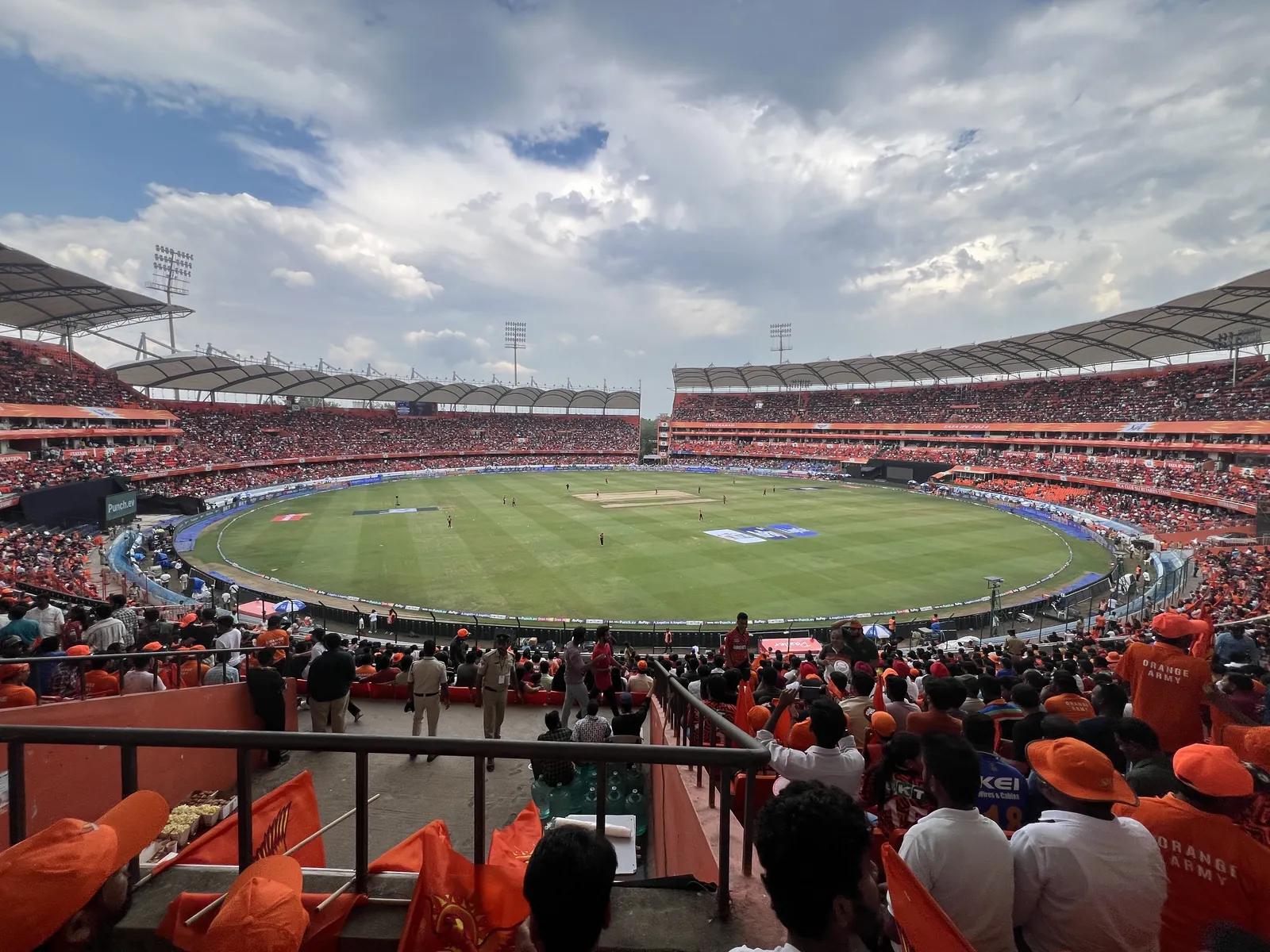
Rajiv Gandhi International Stadium is in Uppal, Hyderabad, and is commonly called Uppal Stadium in match coverage. The venue opened in 2004, has the Pavilion and North ends, and is associated with the Hyderabad Cricket Association and Sunrisers Hyderabad. It hosts international cricket alongside domestic matches and the IPL, but its published capacity figures need careful wording.
The ICC venue page gives a maximum or design capacity of 55,000, while the Cricbuzz venue listing lists 38,000. The sources report different figures, so this article does not present either as the definitive current attendance capacity. The distinction matters because a design maximum, an operating arrangement and an available match-day seating figure are not necessarily the same thing.
The first men’s ODI at the ground was India against South Africa in November 2005. The first men’s Test was India against New Zealand in November 2010, and the first men’s T20I actually played here was India against West Indies in December 2019. A 2017 men’s T20I was abandoned without a toss and is kept separate from the three completed-match T20I sample. On the latest checked venue record, Hyderabad has hosted six men’s Tests, 10 ODIs and three completed men’s T20Is. Method and links are listed in the source notes.
This distinction also protects the Rajiv Gandhi Stadium records from a common data problem: city-wide or older archive pages can mix in matches from Lal Bahadur Shastri Stadium and can contain incorrect summary rows. The figures here are restricted to the Uppal ground and use the checked venue ledger. For readers building a wider ground comparison, the CricWin24 cricket grounds hub places Hyderabad alongside other Indian venues without treating their statistics as interchangeable.
The stadium matters on 14 October because India can clinch the five-match series at home. West Indies need to win to level the contest at 2–2 and take it to a decider. The venue’s history gives India familiarity, but it does not remove the match-up risk: a high-quality powerplay and a clean hitting night can make the surface work for either side.
IND vs WI 4th T20I Context: Why the Hyderabad Pitch Matters
India arrive 2–1 ahead after the Indore match, where India were bowled out for 223 and West Indies reached 209/7, leaving India with a 14-run win. The previous Ranchi game was a different contest: West Indies chased India’s 249/5 with 252/4. Hyderabad therefore follows a narrow India defence, not an India chase of 249. The completed Indore report provides the relevant match context, while the earlier third T20I preview remains an archived pre-match view rather than a result source.
Hyderabad changes the tactical question. A venue with a 297/6 reference point invites aggressive intent, but the 2022 Australia game ended with totals of 186/7 and 187/4, and the 2019 West Indies game featured 207/5 and 209/4. Those scores show that “high scoring” can mean a competitive 185–210 match, not automatically a 250-run shootout. The middle overs, rather than only the first six, may decide whether the innings reaches the top end of that range.
India’s likely advantages are familiarity, a deep batting order and several spin options if the pitch offers grip. The published preview identifies roles around Shreyas Iyer as captain, Abhishek Sharma, Ishan Kishan, Sanju Samson, Tilak Varma, Naman Dhir, Axar Patel, Nitish Reddy and Arshdeep Singh. These are role references, not a confirmed XI; there is no basis here to announce final selections, a toss decision or last-minute fitness news.
West Indies have a different route to control. Their power-hitters can turn a good powerplay into scoreboard pressure, and their left-arm spin resources can challenge India’s left-hand options if the surface slows. The preview names Shai Hope, Kamil Pooran, Shimron Hetmyer, Rovman Powell, Sherfane Rutherford, Roston Chase, Gudakesh Motie and Akeal Hosein among the relevant roles. Romario Shepherd missed Indore because his fitness had not been cleared; this article does not assume that he returns or that he is available in Hyderabad.
The series backdrop makes the toss relevant but not decisive. India’s home record and a moderate pre-match lean favour them, while West Indies remain dangerous if they win the powerplay and carry wickets into the final five overs. Readers can use the archived second T20I preview and the first T20I toss analysis as context, not as evidence of what this particular strip will do.
Rajiv Gandhi International Stadium Pitch Report: Batting or Bowling?
The best answer is batting-friendly first, with bowling value created by timing and variation. Hyderabad’s generic venue description is a flat surface that can slow as a game progresses. A historic local report from 21 April 2026 described a black-soil, flat and dry IPL strip, but that was an IPL match report, not a permanent soil certification or an inspection of the 14 October T20I pitch. The current strip selection, preparation and moisture content are not confirmed in the evidence checked for this article.
That limitation does not make the pitch report unusable. The 164-to-297 T20I spread shows why one label is inadequate: a new ball may travel cleanly, while an older ball can reward changed pace, hard lengths and attacks at the stumps. Captains should read the first two overs rather than follow a fixed venue script.
| Factor | Expected match impact |
|---|---|
| Batting | Strong opportunity if bounce stays true |
| Pace bowling | Moderate new-ball value; variations important later |
| Spin bowling | Useful if the surface grips; control can change with moisture |
| Bounce | Expected to be sufficiently consistent for shots through the line, but not guaranteed |
| Boundary scoring | High potential; exact current dimensions are not verified |
| Chasing | Possible advantage only if the second-innings ball becomes easier to hit |
Powerplay: attack the length, respect the first movement
The first six overs should offer the clearest chance for seamers to find movement. Quality pace can ask questions outside off stump or bring the ball back into right-handers before the pitch settles. That window may be brief. If the ball arrives at a predictable height, openers can play through the line and make the fielding restrictions count without needing speculative swings at every delivery.
For India, Abhishek Sharma’s value is linked to identifying whether the ball is holding. Hope and the West Indies top order likewise need to avoid early wickets. The key is not an assumed powerplay par score but turning good balls into singles and punishing predictable ones. Exact square-boundary distances are unverified, so the captain should judge scoring areas from the first over’s release and bounce rather than rely on fixed measurements.
Middle overs: where grip can alter the innings
The middle overs are the phase most likely to separate a 190-type innings from a 220-type innings. A surface that begins flat can become slightly slower as the ball gets older. That makes finger spin, wrist spin, cross-seam deliveries and pace changes more useful than raw speed. It does not mean the pitch must turn sharply; a small loss of pace can be enough to upset a batter’s timing.
Spinners should vary trajectory and protect against the easy single. Batters, meanwhile, need to rotate before attempting the release shot. If the surface grips, forcing a six every over can create wickets; if it skids on, excessive defensive bowling can leak boundaries. This is also the period in which Axar Patel, Bishnoi-type wrist-spin options and Chase or Motie-style control can matter, subject to the confirmed teams.
Death overs: execution outweighs reputation
At the death, a true bounce and a used ball can again favour the hitter, but only if the batter has wickets in hand. Wide yorkers, straight yorkers, hard lengths aimed at the body and well-disguised slower balls should all have a role. A bowler who misses the intended pace or line may concede more than the surface itself would suggest.
The defensive plan should not assume that dew will arrive after a particular over. If the ball becomes damp, finger-spin grip and slower-ball control may reduce; if it does not, a captain can keep using the most economical match-up. The T20I record supports an aggressive scoring ceiling, not a guarantee that every innings will remain easy at the finish.
Rajiv Gandhi International Stadium T20I Records
Only three completed men’s T20Is have been played at this venue. The 2017 match abandoned without a toss is not counted as a played T20I in the averages or win record. That small sample is enough to describe the ground’s scoring possibilities, but not enough to claim a definitive Hyderabad law about batting first or chasing.
| T20I record | Figure |
|---|---|
| Completed matches | 3 |
| Won batting first | 1 |
| Won chasing | 2 |
| Average first innings | 230.00 |
| Average second innings | 186.67 |
| Average first innings excluding 297/6 | 196.50 |
| Highest team total | 297/6, India vs Bangladesh, 12 October 2024 |
| Lowest recorded team total in the completed sample | 164/7, Bangladesh vs India, 2024 |
| Highest successful chase | 209/4, India vs West Indies, 2019 |
| India’s venue record | 3 played, 3 won |
The first-innings average of 230.00 is not a typical-score promise. India’s 297/6 against Bangladesh is the obvious outlier that lifts it. Remove that innings and the remaining first-innings average is 196.50, a much more useful reference for a normal pre-match scenario. The six innings, in descending order, are India 297/6, India 209/4, West Indies 207/5, India 187/4, Australia 186/7 and Bangladesh 164/7.
All six completed T20I innings, ranked by total
| Rank | Team | Total | Opponent | Date |
|---|---|---|---|---|
| 1 | India | 297/6 | Bangladesh | 12 October 2024 |
| 2 | India | 209/4 | West Indies | 6 December 2019 |
| 3 | West Indies | 207/5 | India | 6 December 2019 |
| 4 | India | 187/4 | Australia | 25 September 2022 |
| 5 | Australia | 186/7 | India | 25 September 2022 |
| 6 | Bangladesh | 164/7 | India | 12 October 2024 |
India won the 2019 and 2022 games by six wickets, then beat Bangladesh by 133 runs in 2024. The 297/6 was India’s record T20I total when it was scored; this table claims the checked venue record, not an independently refreshed worldwide team record.
Virat Kohli has 157 T20I runs for India at this venue across two matches, the most for India in this sample. Samson’s 111 from 47 balls is another notable single-innings contribution from the archive. For India’s venue bowling figures, Chahal, Axar Patel and Ravi Bishnoi have three wickets each. These are cumulative wickets from the three completed matches, not a forecast for a bowler’s returns on 14 October.
Rajiv Gandhi International Stadium ODI Records
The ODI record supplies a larger, though still format-specific, view of the ground. Ten ODIs have been counted at Uppal: seven India ODIs from 2005, 2007, 2009, 2011, 2014, 2019 and 2023, plus three 2023 World Cup games. Two warm-up matches and matches at Lal Bahadur Shastri Stadium are excluded.
| ODI venue record | Figure |
|---|---|
| Matches | 10 |
| Won batting first | 6 |
| Won chasing | 4 |
| Average first innings | 296.80 |
| Average second innings | 261.10 |
| Highest team total | 350/4, Australia vs India, 2009 |
| Lowest team total | 174 all out, England vs India, 2011 |
| Highest successful chase | 345/4, Pakistan vs Sri Lanka, 2023 |
| Lowest successful defence | 290/7, Australia vs India |
The recomputed averages, 296.80 and 261.10, are more precise than rounded provider displays. They suggest that setting a large total has generally been the more common winning route in this ODI sample, but the 345/4 Pakistan chase is a reminder that a high target is not automatically safe. The venue is capable of supporting a long chase when the innings retains wickets and the ball comes on.
The individual ODI record also shows the scale of the ground’s batting days. Shubman Gill’s 208 against New Zealand in 2023 is the checked individual high, followed by Sachin Tendulkar’s 175 against Australia in 2009. The 2023 New Zealand–Netherlands World Cup match finished New Zealand 322/7 and Netherlands 223, a 99-run margin; an older HCA summary copied that score incorrectly, so the corrected scoreline is used here.
ODI evidence informs but does not dictate a T20I forecast: 50 overs allow recovery and changing conditions, while T20 decisions are compressed into a few powerplays, match-ups and death overs.
Rajiv Gandhi International Stadium Test Records
Six men’s Tests have been hosted at the ground. The venue’s Test results are India four wins, England one win and one draw. The first was the drawn India–New Zealand Test in 2010. The other relevant results include India’s innings win over New Zealand in 2012, Australia’s defeat in 2013, Bangladesh’s loss in 2017, West Indies’ 2018 defeat and England’s 2024 win by 28 runs.
| Test venue record | Figure |
|---|---|
| Tests hosted | 6 |
| India wins | 4 |
| England wins | 1 |
| Draws | 1 |
| Highest total | India 687/6 declared vs Bangladesh, 2017 |
| Lowest total | West Indies 127 all out vs India, 2018 |
| Average first innings | 378 (provider display) |
| Average second innings | 387 (provider display) |
The 378 and 387 figures are Cricbuzz provider displays, not independently recomputed audits. They should not be mixed with the recomputed ODI and T20I averages. Test cricket is not a direct 20-over forecast, but the 687/6 declaration and West Indies’ 127 show that Hyderabad can reward strokeplay before making timing difficult as a surface wears. A T20 plan therefore needs answers for both pace-on and gripping conditions.
India’s Record at Rajiv Gandhi International Stadium
India have won all three completed men’s T20Is at Hyderabad: against West Indies in 2019, Australia in 2022 and Bangladesh in 2024. The strongest statistical statement is therefore 3–0, not a claim that India are guaranteed to win the fourth match. Their most recent T20I performance at the ground was especially emphatic: 297/6 followed by a 133-run win over Bangladesh.
Across the three international formats counted here, India’s venue record is four wins, one loss and one draw in Tests; four wins and three losses in ODIs; and three wins from three completed T20Is. Those totals provide context for home familiarity, but each format has a different sample and match environment. A T20I should not inherit the entire Test or ODI record as if the conditions and tactics were identical.
India’s advantage is practical: local reference points, varied bowling profiles and a 3–0 T20I record. The challenge is avoiding overconfidence from 297/6; the 2019 and 2022 wins were closer to the 185–210 type of match that may face either side on 14 October.
For supporters following the wider Hyderabad cricket ecosystem, the SRH retained, released and traded players analysis and the IPL league hub add context around the venue’s modern T20 identity. They do not alter the international record or confirm the teams for this fixture.
Hyderabad Toss Prediction: Bat First or Bowl First?
The raw T20I toss-and-result signal favours chasing: two of the three completed matches were won by the side batting second. That is a useful starting point, not a command to bowl first. India’s 2024 defence of 297/6 proves that a large first-innings score can overwhelm the chase even at a venue associated with batting.
The toss winner may prefer to field if the later ball looks easier to hit, but the decision should follow the inspection. Dew is conditional, not confirmed; if the surface grips and stays dry, batting first may be more attractive before it slows.
| Match scenario | Sensible reading |
|---|---|
| Toss winner bowls first | Slight advantage only if the later ball is easier to hit |
| Toss winner bats first | A true surface can reward a 190–215 plan from either team |
| Surface grips early | The same total may be worth more because timing is harder |
| First-innings score above 220 | Strong pressure, but not a guarantee of victory |
| Chasing a modest total | Wickets in hand matter more than the venue label |
Rather than call 190 “safe”, the better scenario is this: 190–215 is a competitive first-score range when the pitch is true; a lower total can remain relevant if the surface grips; and even 220-plus is not a guarantee if West Indies or India preserve wickets for the finish. That is a more defensible toss prediction than assigning fixed asymmetric ranges to the two teams.
Hyderabad Weather and Dew Report for IND vs WI 4th T20I
The Open-Meteo forecast was retrieved on 13 October 2026 and is valid for 14 October, using the stadium-area grid. At 7:00 PM IST, the model shows 29.0°C, 50% relative humidity, a 17.4°C dew point, 1% precipitation probability, 10.2 km/h wind and 98% cloud cover. At 9:00 PM, it shows 27.4°C, 56% humidity, a 17.9°C dew point and zero precipitation probability.
That is a low rain-threat forecast for the scheduled 7:00 PM start, so the available evidence supports a good chance of a full match. It remains a forecast rather than an observation, and conditions can change before the toss. The model does not prove that dew will settle, nor does it establish that the ball will become slippery after 12–15 overs. The correct editorial position is “possible later moisture, monitor the update”.
If dew develops, finger-spinners may lose grip and chasing may become easier; if it does not, changes of pace and spin remain viable. Captains should inspect the ball and outfield rather than apply a fixed Hyderabad dew rule.
How Bowlers Can Succeed at Hyderabad
The bowling plan should accept that runs are available and build pressure through repeatable skills. The aim is to make batters hit to less comfortable areas without claiming that any boundary dimension is permanently short.
New-ball pace
Seamers should test movement for the first two overs with a full enough length to threaten the edge, then move to hard lengths if the ball begins to skid. Arshdeep’s left-arm angle can create a different release problem from right-arm pace, while India’s other pace roles must be confirmed at the toss. West Indies need the same discipline: a heavy top-order attack does not remove the need for wicket-taking lines.
Spin and pace-off through the middle
Spin is most valuable when the bowler can change the batter’s preferred tempo. Finger-spinners can attack the stumps and force the hitter to clear the larger part of the field; wrist-spinners can vary googly, leg-break and trajectory if the surface offers even modest purchase. Axar, Bishnoi and other options may be important for India, while Motie, Hosein and Chase bring different left-arm or off-spin angles for West Indies, subject to selection.
The record has three India bowlers tied on three T20I wickets at the venue—Chahal, Axar Patel and Bishnoi. That is evidence that spin has contributed to India’s wins, not proof that a particular spinner will dominate this match. The pitch needs to be read in real time.
Death-overs execution
Wide and straight yorkers, hard body lines and slower balls should be sequenced rather than used randomly. If dew appears, pace through the pitch and yorker accuracy may become more valuable than a cutter; without it, disguise remains the priority.
How Batters Can Score at Hyderabad
The scoring method begins with trust in the bounce, not blind aggression. When the ball comes on, drive and pull through the line; when it holds, use the crease, rotate and wait for the miss. The record supports a high ceiling, not a boundary attempt on every delivery.
Powerplay batting
Openers should establish whether the ball is swinging and whether the pitch is carrying before committing to lofted shots. Abhishek Sharma’s attacking role can pressure the field, while Kishan, Hope and other top-order batters may prefer to access gaps before expanding. A six-over score is only useful if it preserves enough wickets for the middle order; a reckless start can turn a 210 possibility into a recovery innings.
Middle-order match-ups
The middle overs are the time to attack spin selectively. A batter who sweeps, uses the feet or creates a strong hitting angle can disturb a bowler’s length, but the shot must match the degree of grip. Tilak, Samson, Pooran, Hetmyer and Powell-type roles can change the game quickly, although the final XI and batting positions are not confirmed. The key is to target the right over, not merely the biggest name.
Finishing with wickets intact
At the end, a set batter can exploit pace and fielding restrictions without relying on unverified boundary measurements. Hard running prevents a bowler settling into a defensive line; a 200-plus finish is more plausible with two established hitters beyond 15 overs.
| Innings view | Competitive reference |
|---|---|
| First innings on a true surface | 190–215 is competitive for either side |
| First innings if the pitch grips | A lower total can still create pressure |
| Chasing calculation | Preserve wickets; do not assume 190 is safe |
| 220-plus first innings | Strong pressure, not a guaranteed result |
The 230.00 average needs its 297/6 caveat. A realistic match-reading benchmark is a broad 180–210 contest, with a higher total possible if the pitch is true and the powerplay is won.
What the Hyderabad Pitch Means for India vs West Indies
Hyderabad slightly favours India because of home familiarity, a 3–0 completed T20I record and the flexibility of its spin resources. That is a measured edge rather than a guarantee. West Indies can erase it by winning the powerplay, forcing India’s middle order to face spin under pressure and keeping wickets for the final five overs.
India’s route to control
India should seek a positive but information-rich start: attack the loose ball, preserve one set batter through the middle and use spin before any possible late moisture reduces grip. If the pitch is flat, the batting depth can turn a good platform into 200-plus. If it slows, India’s ability to vary tempo and defend with multiple bowling styles becomes more important.
The risk is treating 2024 as the normal template. India can post another huge score, but 2019 and 2022 show that a chase around 190–210 is plausible; planning only for 297 can miss the quieter middle-over battles.
West Indies’ route to control
West Indies need their power-hitters to convert the first six overs without exposing too many wickets. A strong start can force India to use match-up bowlers earlier and open space for Powell, Hetmyer, Rutherford or Pooran-type finishers. Their spin options can then attack India’s left-hand and right-hand combinations, provided the surface offers enough grip and the ball remains manageable.
The decisive question is whether West Indies remain in the match after 15 overs. Posting or chasing around 190 with wickets in hand keeps them dangerous; a cluster of middle-over wickets can make the high-scoring surface a false comfort.
Measured tactical prediction
Expect a batting-friendly pitch with a moderate India lean. The venue does not justify a guaranteed winner, fixed safe score or full-match dew assumption. India’s familiarity and spin depth give them the stronger base case, but West Indies’ power keeps the contest live; the XI, toss and first two overs should update the judgement.
Rajiv Gandhi International Stadium: Stats at a Glance
| Format | Matches | Highest total | Average first innings | Average second innings |
|---|---|---|---|---|
| Test | 6 | 687/6d | 378* | 387* |
| ODI | 10 | 350/4 | 296.80 | 261.10 |
| T20I | 3 completed | 297/6 | 230.00 | 186.67 |
* Test averages are provider-display figures from the checked venue page; they are not presented as independently recomputed. The ODI and T20I averages use the checked ledgers and calculations. The T20I row excludes the 2017 abandoned match, and all three formats refer to the Uppal ground rather than mixed Hyderabad city records.
For a broader Indian-ground comparison, readers can also see our Ekana Cricket Stadium Lucknow pitch coverage and JSCA International Stadium Complex Ranchi venue page. Those links are useful for navigation, not substitutes for the Hyderabad evidence in this article.
10 FAQs: Hyderabad Pitch Report and Stadium Records
What is the Rajiv Gandhi International Stadium pitch like for T20 cricket?
The available evidence points to a batting-friendly venue with scoring potential and generally usable bounce, but not a guaranteed flat track. The completed T20I sample ranges from 164/7 to 297/6. A black-soil description comes from an April IPL report, not a current October pitch inspection, so grip and pace should be confirmed after the toss.
What is the highest T20I score at Hyderabad?
India’s 297/6 against Bangladesh on 12 October 2024 is the highest men’s T20I total in the checked Uppal venue record. It is also why the overall first-innings average reaches 230.00. That total shows the ceiling of the ground, not the score every team should expect in the IND vs WI fourth T20I.
How many men’s T20Is have been played at Rajiv Gandhi International Stadium?
Three men’s T20Is have been completed at the venue: India against West Indies in 2019, India against Australia in 2022 and India against Bangladesh in 2024. A 2017 match was abandoned without a toss and is kept separate. Therefore, the venue’s T20I win and average figures use three completed matches only.
Is Hyderabad pitch good for spinners?
Spinners can be effective when the surface slows or grips, especially through the middle overs. The venue record has Chahal, Axar Patel and Bishnoi on three India T20I wickets each. That is a shared sample mark, not a guarantee of dominance. If late moisture develops, grip and control may become more difficult for some spinners.
Is Rajiv Gandhi International Stadium good for chasing?
Two of the three completed men’s T20Is were won by the chasing side, so chasing is a credible option. However, India defended 297/6 in 2024, proving that a huge total can override the chase trend. The toss decision should depend on the inspected pitch, the ball’s pace and whether later moisture is actually present.
What is the average score at Hyderabad in T20Is?
The checked venue calculation gives an average first-innings score of 230.00 and an average second-innings score of 186.67 across three completed men’s T20Is. Excluding India’s 297/6, the first-innings average is 196.50. The smaller adjusted number is a better guide for a normal match scenario than 230 alone.
What is India’s T20I record at Rajiv Gandhi International Stadium?
India have played three completed men’s T20Is at Hyderabad and won all three. The victories came against West Indies in 2019, Australia in 2022 and Bangladesh in 2024. The record gives India home familiarity and a positive historical base, but it does not guarantee a fourth win against West Indies.
How will the pitch behave in the IND vs WI 4th T20I?
The expected starting point is good batting conditions with enough bounce for shots through the line. New-ball seamers may find brief movement, while cutters and spin could matter if the pitch slows. Dew is possible but not confirmed by the forecast. The final reading should use the toss inspection and the first two overs.
What is a competitive score in Hyderabad for this T20I?
There is no single safe score. On a true surface, 190–215 is a competitive first-score range for either team; if the pitch grips, a lower total can remain relevant. A score above 220 creates pressure but is not a guarantee, as wickets, match-ups and the second-innings conditions still determine the chase.
Who has the most India T20I runs at the Hyderabad venue?
India won the 2019 and 2022 games by six wickets, then beat Bangladesh by 133 runs in 2024. The 297/6 was India’s record T20I total when it was scored; this table claims the checked venue record, not an independently refreshed worldwide team record.
Source notes
Records were checked against original scorecards and the venue sources below on 13 October 2026. Completed men’s internationals at Uppal are kept separate from IPL, warm-ups and matches at the older Hyderabad ground.
- Hyderabad Cricket Association men’s T20 archive — completed venue T20I scorelines and the abandoned 2017 match.
- Cricbuzz Rajiv Gandhi International Stadium venue record — format counts, provider displays and venue listing.
- ICC Rajiv Gandhi Stadium venue profile — venue identity and published design-capacity context.
- BCCI India vs West Indies, 4th T20I match details — fixture date, start time and venue.
- Open-Meteo forecast API used for 14 October 2026 — forecast retrieved 13 October 2026; valid date 14 October 2026.