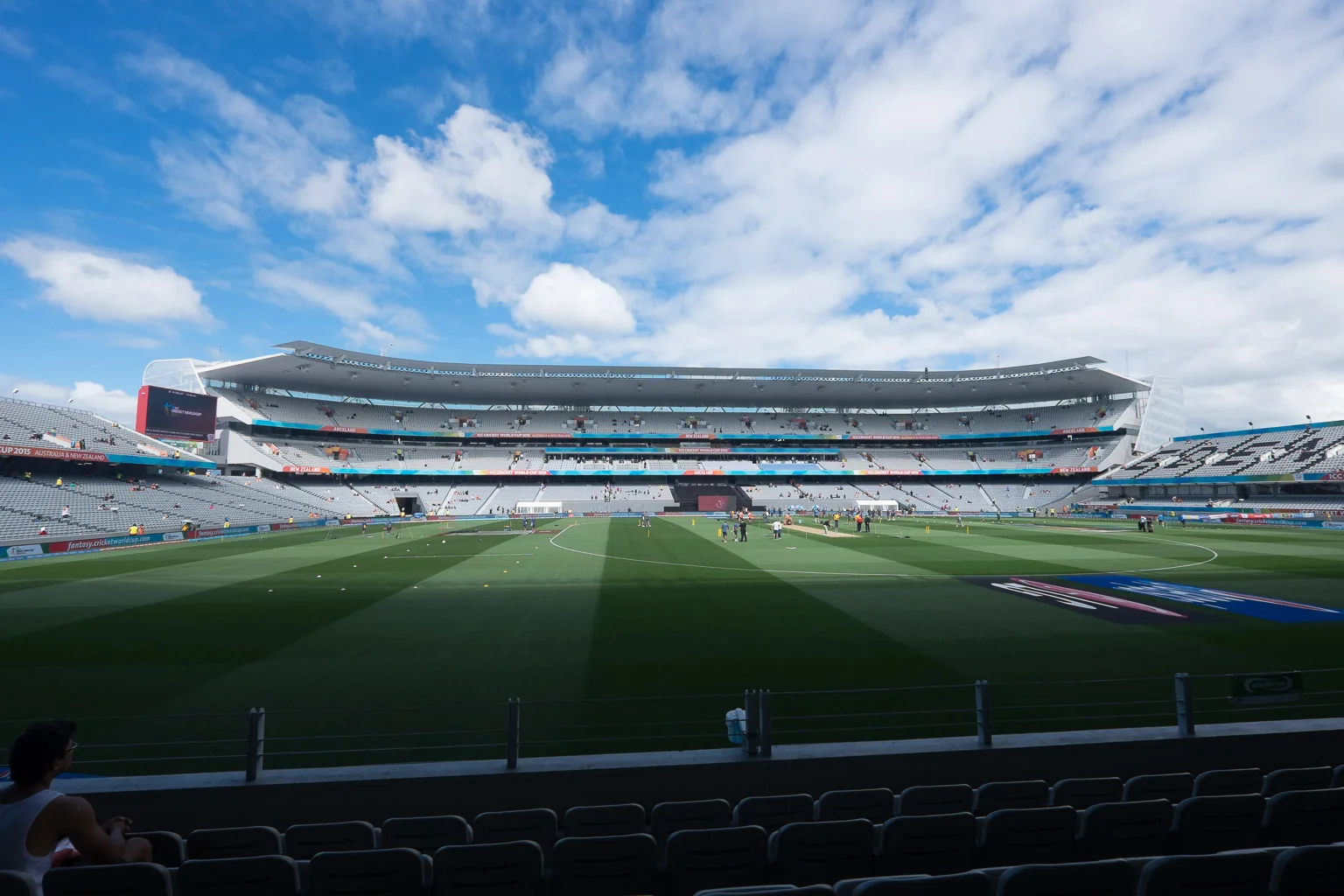
The Eden Park pitch report for New Zealand versus India on Wednesday 4 November 2026 has to begin with a distinction: this is an ODI assessment prepared on 3 November, not a report from a completed inspection of the match strip. No physical strip inspection or official match-specific pitch report was publicly available when this guide was checked. The conclusion is conditional. The main Auckland square is expected to offer good bounce, while the 50-over surface should not simply be assumed to behave like the flatter T20I strip used a few days earlier. The short, uneven boundary geometry will reward clean hitting only after batters negotiate the new ball.
This is a venue guide for the New Zealand vs India Eden Park fixture, a day-night ODI scheduled for 3:00 pm local time at Eden Park No. 1 in Auckland. It explains what the records do and do not prove, why a 340/5 chase can sit beside a 73 all-out collapse, how the reported 2022 chase should be read, what the dated Eden Park weather forecast actually says, and how spectators can plan a visit without relying on a promise about seats, gates, parking or free transport. The Eden Park Auckland pitch report is most useful when it treats uncertainty as information rather than disguising it with a false hourly grid.

Eden Park pitch report today: the short version
For readers searching for an Eden Park pitch report today, the relevant “today” is the dated assessment prepared on Tuesday 3 November for the ODI on 4 November. The strip has not been inspected in the available published material. The preview describes a bouncy Eden Park surface and expects the ODI pitch to differ from the flatter T20I surface. That makes the safest pre-match reading a fresh international square with the prospect of carry and early seam movement, not a guaranteed batting belter.
A first innings in the broad editorial range of 260–300 is a balanced planning reference for this match, not an Eden Park historical average and not a prediction of the exact score. A score above 300 becomes realistic if the surface is genuinely true and batters preserve wickets; a total below 250 becomes plausible if movement, bounce or poor shot selection dominates. Those ranges are tactical scenarios, not sourced venue statistics. The ground's history gives support for both extremes, but it does not turn either into a guaranteed par.
The batting plan is to earn the right to attack: play late early, use the straight boundaries once the ball softens, and preserve a pair of set batters for the last 15 overs. The bowling plan is to make the short straight boundaries irrelevant through length discipline, late movement, hard hands avoided in the channel, and yorkers or well-disguised variations at the death. New Zealand's home familiarity matters, but the dimensions can punish any side that bowls predictably.
Match setting and what the ground actually is
The 4 November New Zealand vs India Auckland ODI is part of the India tour of New Zealand 2026. It begins at 3:00 pm in Auckland, 2:00 am UTC and 7:30 am IST, according to the official NZC international schedule. The match will move from afternoon into evening, so the interaction between the first spell, changing light and any later moisture should be discussed as a possibility rather than a confirmed dew pattern. There is no completed toss at the time of writing, no confirmed final XI in current team news and no result to report.
Eden Park describes itself as New Zealand's national stadium (official venue history). Its official address is 42 Reimers Avenue, Kingsland, Auckland, New Zealand. That identity is more than a marketing label: the venue hosts major cricket and rugby events and is a central part of Auckland's sporting geography. For this article, however, “Eden Park” means the Main Stadium or Eden Park No. 1 international cricket ground. It does not mean every cricket match played in the wider precinct.
That distinction matters because the Outer Oval is a separate ground. Cricinfo assigns the Main Stadium ground ID 283 and maintains a separate record page for Eden Park Outer Oval, Auckland, ground ID 724. The current 2026 preview says Auckland domestic matches are played on the Outer Oval, while the international ODI square discussed here is in the main venue. A domestic result at the Outer Oval cannot be quietly added to the Main Stadium's ODI record, and the fact that domestic cricket uses the other oval does not prove that its surface is identical to the international pitch.
The official accessibility map reinforces the physical distinction. It labels the Outer Oval, North Stand, South Stand, East Stand, West Stand, Cricket Avenue, cricket nets, the Cricket Pavilion, Kingsland Station and the bus hub. This is an Auckland cricket stadium with several operating zones, not one undifferentiated rectangle. When a guide says Main Stadium, it is narrowing the sample so that Eden Park ODI statistics remain comparable.
The venue's location also affects match-day planning. Eden Park is close to Kingsland Station, with Morningside Station within walking distance and bus routes nearby. That central setting makes public transport the sensible default for many spectators, particularly because the venue says general-public onsite parking is not available for game days. It is a stadium embedded in a neighbourhood, not an out-of-town ground built around a large free car park.
Eden Park stadium history and identity
The Eden Park stadium history begins in the official account with the site's story in 1900. In 1902, Harry Ryan and fellow cricketers leased the rough Kingsland paddock and formed the Eden Cricket Club. Auckland Cricket made the Park its home in 1910. Auckland Rugby Union leased it in 1914 and formally made it its home in 1925. A Trust was established in 1926, and Eden Park Trust manages the venue today. These dates describe a gradual sporting institution rather than a single opening ceremony that can be treated as the whole history.
A historical photograph can help readers visualise that evolution, but it must not be used as current evidence. The archival photo is a 2015 photograph of the South Stand, credited to Tim Bray and licensed CC BY-SA 4.0. It is a genuine venue image, but it is not a current 2026 pitch, weather or facilities report. The image's file metadata and the source description also contain different contextual clues about the date and an event reference, so this article does not claim that it depicts a particular semifinal or match day.
Capacity, seating and configuration
The Eden Park seating capacity is best reported in layers. The venue's official Facts (Not Fiction) material states a maximum of 50,000 for sport and a concert scale of 65,000. Those are configuration capacities, not an assurance that 50,000 seats will be sold or opened for this ODI. New Zealand Cricket separately reported an approximate capacity of 39,700 for the 30 October 2026 T20I event at Eden Park. That event-specific number shows how a match setup can be smaller than the venue's official sports maximum.
Cricbuzz displays 41,000 in a facts panel, while older profile text has carried 50,000. These values should not be collapsed into one supposedly universal figure. The responsible wording for this guide is: Eden Park's official maximum sports capacity is up to 50,000, concert scale is up to 65,000, and event configuration varies. The approximately 39,700 figure belongs to the 30 October T20I event and must not be presented as the guaranteed seating capacity for the 4 November ODI.
Eden Park boundary dimensions and ground shape
The Eden Park boundary dimensions are unusually important because they are not symmetrical in the way a casual diagram might suggest. A 2013 Cricinfo report following reconfiguration recorded square boundaries of approximately 66 metres and noted that a former irregular boundary could be as short as 51 metres. A 2015 Cricinfo report recorded straight boundaries at 55 metres from the centre of the pitch, which implies roughly 65 metres beyond the bowler and 45 metres behind the wicketkeeper.
Those are reported, orientation-specific measurements, not a verified map for 4 November 2026. No official rope map for this ODI was located. The safe interpretation is that Eden Park has short, asymmetric scoring options and that historical measurements illustrate the shape without guaranteeing the exact rope placement. The phrase Eden Park ground dimensions should not be used to imply a perfect circle or a current four-sided measurement table.
The geometry changes shot value. A batter who clears the infield straight can find a shorter route than a player aiming to hit a conventional deep square boundary. At the same time, a bowler who misses full may offer a drive into a short straight arc, while a predictable short ball can be pulled or hooked into a short fine-leg or third-man corridor. Fielders must be placed for the actual angles rather than for a generic round ground.
The short boundary does not eliminate the value of defence. A batter still has to meet the ball cleanly, and bounce can alter the contact point. A ball that climbs more than expected can turn a controlled pull into a top edge. A ball that moves late can make the close rope irrelevant because the batter never controls the face. This is why the Eden Park cricket ground should be called a high-reward venue with high execution demands, not simply a small ground.
Eden Park ODI records: the verified Main Stadium sample
The following table covers men's ODIs at the Main Stadium and excludes the Outer Oval, Tests, T20Is, women's matches and unverified cross-format comparisons.
| Category | Verified Main Stadium ODI record | Match context |
|---|---|---|
| Highest team innings | New Zealand 340/5 in 48.4 overs | v Australia, 18 February 2007; New Zealand won by five wickets while chasing |
| Lowest team innings | New Zealand 73 all out in 26.3 overs | v Sri Lanka, 6 January 2007; Sri Lanka won by 189 runs |
| Highest individual innings | Marcus Stoinis 146* from 117 balls | Australia v New Zealand, 30 January 2017; New Zealand won by six runs |
| Best bowling innings | Mitchell Starc 6/28 in 9 overs | Australia v New Zealand, 28 February 2015; New Zealand won by one wicket |
The highest total is New Zealand's 340/5 against Australia on 18 February 2007. It was a chase, not a first-innings total, and that detail matters. The card records a large successful pursuit completed in 48.4 overs, so it demonstrates that Eden Park can support sustained scoring when a side retains control through the middle overs. It does not tell us that every first innings at the venue should be projected above 300.
The lowest total is New Zealand's 73 all out against Sri Lanka on 6 January 2007. A low score of this kind is a reminder that a short boundary does not cancel out seam, bounce, movement or poor shot selection. It is an outlier record, not a forecast for 2026, but it is useful evidence against a simplistic “batting paradise” label.
The Eden Park highest ODI score by an individual is Marcus Stoinis's unbeaten 146 from 117 balls for Australia on 30 January 2017. Australia made 280, yet New Zealand won by six runs. The innings is therefore both a record batting performance and a warning against reading individual brilliance as a guarantee of team success. Stoinis found the boundary repeatedly, but New Zealand held the match by defending the total.
The best listed bowling performance is Mitchell Starc's 6/28 in nine overs against New Zealand on 28 February 2015. Australia made 151 and New Zealand won by one wicket, so the spell did not produce an Australian victory. It does, however, show how quickly the new ball and high-quality pace can overwhelm the surface's boundary appeal. These records explain the range of Eden Park cricket records more honestly than a single average does.
The lowest listing is also why Eden Park lowest ODI score searches need a format and scope label. The figure is a men's ODI innings at the Main Stadium, not the lowest score in every cricket format ever played at the site. The highest and lowest records are endpoints, not a balanced description of every strip.
New Zealand and India at the Main Stadium
Cricinfo's Main Stadium results list contains 10 completed or listed New Zealand–India ODIs through 11 January 2025. New Zealand have won six, India have won three and one match was tied. There were no no-results in that listed set. This is the venue-specific sample, not the overall bilateral record and not a claim about the 2026 match.
| Date | Result at the Main Stadium |
|---|---|
| 22 February 1976 | New Zealand won by 80 runs |
| 14 February 1981 | New Zealand won by 78 runs |
| 27 March 1994 | India won by 7 wickets |
| 16 January 1999 | India won by 5 wickets |
| 26 December 2002 | New Zealand won by 3 wickets |
| 11 January 2003 | India won by 1 wicket |
| 14 March 2009 | New Zealand won by 8 wickets |
| 25 January 2014 | Match tied |
| 8 February 2020 | New Zealand won by 22 runs |
| 25 November 2022 | New Zealand won by 7 wickets |
The 25 November 2022 scorecard is the most relevant modern case study. India made 306/7 in 50 overs after New Zealand won the toss and chose to field. New Zealand reached 309/3 in 47.1 overs, winning by seven wickets with 17 balls to spare. Tom Latham made 145 not out from 104 balls and Kane Williamson made 94 not out from 98. The match flow records India scoring 96 in its final 10 overs and New Zealand scoring 68 in its final 10.
That chase is not proof that 306 is unsafe everywhere. It shows something narrower and more useful: a competitive-looking total can be neutralised when a stable top-order partnership survives the early phase and keeps wickets for the closing overs. A chasing side may use the short dimensions more effectively once it knows the target and has two set batters. Conversely, an early collapse can make the rope irrelevant.
Venue averages, batting first and the limits of the card
The Cricbuzz venue card displays 86 ODIs, 34 wins batting first, 47 wins bowling first, an average first innings of 222 and an average second innings of 194. These are the source-reported values available for readers looking for the Eden Park average ODI score, Eden Park first innings average score or Eden Park second innings average score.
They must be qualified. The public card does not state a clear cutoff, explain how ties and no-results are treated, or show a full reconciliation with the upcoming 2026 ODI. Cricinfo's readable results list extends through 11 January 2025, but it does not publish the same average table or a complete toss dataset. The values 222 and 194 should therefore not be presented as an audited current sample as of 4 November 2026.
The batting-first and bowling-first counts have the same limitation. The card reports 34 wins batting first and 47 wins bowling first, but those values do not by themselves provide a complete audited sample. It would be misleading to divide them into a percentage and call it the venue's toss edge. Eden Park ODI statistics need a consistent match list, treatment of ties and no-results, and an explicit cutoff before a statistical conclusion is made.
Toss statistics are unavailable from a complete, explicitly cutoff public sample inspected for this guide. The 2022 scorecard confirms that New Zealand won the toss and fielded in that match; it does not establish a ground-wide pattern. The Eden Park toss prediction should therefore be conditional: a captain may prefer to field if the ball is expected to move early and the chase is considered easier under lights, but that is a strategic choice, not a historical toss statistic.
Eden Park batting or bowling pitch?
The question “Is Eden Park a batting or bowling pitch?” has no responsible one-word answer. The records show both scoring range and wicket-taking threat. The 340/5 chase and Stoinis's 146* demonstrate the value of pace on the bat and clean boundary access. The 73 all out and Starc's 6/28 demonstrate that new-ball movement, bounce and disciplined attack can dominate. The most accurate label is a batting surface when the batter controls length, with an early advantage for bowlers who use movement and bounce. That is the practical Eden Park Auckland cricket stadium reading.
The 3 November Cricinfo preview says the ODI pitch should differ from the flatter T20I surface used four days earlier, expects good bounce and notes that the main ODI square remains fresh because Auckland domestic matches are played on the Outer Oval. That is a preview-based expectation, not an inspected-strip fact. The Outer Oval scheduling detail supports the possibility of a fresh international square, but it does not prove how this exact strip will behave.
A fresh surface can make the first 10 overs tactically important. Seamers need not chase theatrical swing; a disciplined fourth-stump channel, upright seam and good use of the crease can create uncertainty. Batters should leave outside off, play with soft hands and resist reaching for width. The goal is preserving the ability to cash in when the ball loses its sharpest movement. These are the Auckland cricket stadium pitch conditions to monitor.
Bounce matters because it changes the scoring map. A batter who expects a comfortable pull may receive a ball higher than anticipated. A bowler who uses the short ball without a plan may feed the short fine-leg or third-man boundary. The right length is therefore not fixed: it depends on pace, bounce, wind direction, batter position and the field. A hard length can be difficult to hit when it climbs, but a predictable hard length can become a scoring pattern.
Spin has a different job. On a surface with carry, a spinner can vary trajectory and speed, ask batters to hit against the larger or more protected arc, and attack the partnership rather than merely defend singles. The venue's short straight boundaries make a full ball dangerous, so flight must be supported by a field and a release that deny easy lofted drives. Eden Park spin bowling conditions are therefore about control and matchup more than a claim that the pitch will turn sharply.
New-ball movement, powerplay and middle overs
In the powerplay, the first question is whether the ball carries consistently to the keeper and slips. A seam attack that holds a disciplined line can make the batter hit through the riskier portion of the bat. The two straight boundaries may be short, but they are not automatically available if the bowlers keep the ball just full enough to draw a checked drive and just far enough outside the hitting arc.
For batters, the first 10 overs should be treated as an information phase. Watch whether the ball swings late, whether bounce is even and whether the off-side rope is shorter in the actual setup. Use the crease to disturb length, but do not confuse movement with an invitation to manufacture shots. A strong powerplay is not only a high run rate; it is also wickets preserved for the phase in which the ground's geometry becomes more valuable.
The middle overs demand a different type of patience. Fielding angles at Eden Park can make conventional square plans unreliable. A batter may prefer to target straight or behind-square zones after reading the rope, while a bowler may need to make the batter hit across the line rather than offer a simple drive. Running between wickets becomes important because a boundary plan based on the wrong side of the ground can expose a wicket.
A partnership should divide the risk. One batter can use the crease and rotate against spin, while the other targets a matchup or a shorter boundary only when the ball is in the correct zone. The aim is to reach the final 10 overs with two established batters and enough wickets for a calculated escalation. The 2022 chase illustrates this principle: Latham and Williamson's unbeaten partnership converted control into a seven-wicket win rather than relying on constant early boundary hitting.
The death overs are where the venue's geometry can magnify both skill and error. Full tosses and overpitched balls can disappear straight, while a short ball without disguise can reach a short boundary. Yorkers, wide lines, changes of pace and fielders positioned for the actual rope are sensible options, but none is automatic. A slower ball that sits up is worse than a well-executed conventional delivery; a wide yorker that misses its line can become a free boundary.
The batter's late-innings plan should be based on the delivery rather than the reputation of the ground. Clear the front leg when the bowler misses length, use the straight arc when it is open, and keep a running option for balls that are too wide to hit safely. At a 50-over venue, a side can still win the last phase by taking singles and converting two boundary balls per over; it need not attempt sixes from every delivery.
Batting strategy for New Zealand and India
Daryl Mitchell is the most significant current ODI batting input in the current ODI team statistics, with 692 runs at an average of 98.85 in the last-one-year table. That is a measurement-window statistic, not a career venue record. He suits a surface where strong contact and controlled acceleration matter, but the ground does not guarantee that his recent rate will transfer. Latham's role is more about absorbing the match situation, using gaps and keeping the chase organised; his 145 not out in 2022 remains a venue-specific example rather than a forecast.
India's likely top order of Rohit Sharma, Shubman Gill and Virat Kohli offers a different kind of control. Gill's last-one-year ODI table shows 895 runs in 11 innings at 111.87, Kohli's shows 854 in 12 innings at 85.40, and Rohit's shows 750 in 15 innings at 50.00. These are strong recent numbers, but they are not Eden Park averages. The opening challenge is to translate recent form into a method that respects bounce and movement.
KL Rahul offers India a stabilising wicketkeeper-batter option. His supplied career ODI line is 3,541 runs in 101 matches at 51.31, with a strike rate of 92.38, nine hundreds and 20 fifties; his latest ODI before this match was 129 not out against West Indies on 3 October 2026. Those figures establish experience and current evidence, but they do not promise a score in Auckland. His best tactical value may be the ability to change gears after the first movement phase.
In a 50-over innings, India should avoid allowing the short boundary to dictate every shot. The top order can use the first 10 overs to judge carry, then rotate against spin and preserve a left-right or right-left combination where possible. A middle-order player who arrives after two wickets down should not be forced to attack immediately because the ground looks small; rebuilding may be the fastest route to a large total.
Bowling strategy and player types suited to the venue
The most valuable fast bowler at Eden Park is not simply the quickest. It is the bowler who can hold a length that produces uncertain contact, move the ball late and adjust to the actual rope. New Zealand's possible combination includes Kyle Jamieson, Jacob Duffy and Matt Henry or Blair Tickner, with Henry's readiness still being assessed at the 3 November team-news check. That uncertainty means no bowler should be described as confirmed for the XI. These are the Eden Park fast bowling conditions in practical terms.
Jamieson's height can make bounce a tactical asset if he maintains control. A tall bowler who overpitches loses the benefit of the short boundary; one who varies his release point and attacks the top of off can bring the edge and the top of the bat into play. Duffy or Tickner may provide a different angle and pace, while Santner and Bracewell can control the middle phase if the seamers create pressure.
India's potential attack includes Mohammed Siraj, Arshdeep Singh and Gurnoor Brar, with Axar Patel and Nitish Kumar Reddy contributing balance; Kuldeep Yadav remains a selection alternative. Prasidh Krishna is unavailable for the ODI series and must not be inserted into a projected Auckland XI. Siraj is available for the first ODI before moving to India A, and Nitish is also available only for the opener, which makes the first-match combination unusually specific.
Weather forecast for Auckland on 4 November 2026
The Eden Park weather on 4 November 2026 comes from MetService's Auckland Central or Central Auckland forecast area, not an Eden Park-specific station. The written forecast available at the 3 November forecast check said: mainly fine, a chance of a shower until evening, and northeasterlies. It gave a daily high of 22°C and low of 16°C. The forecast was shown as issued at 20:43 on Monday 2 November in Auckland time.
This is a dated forecast, not observed match-day weather. MetService can update forecasts and warnings. The supplied public page did not provide an unambiguous Wednesday 3 pm row for humidity, wind speed, wind gust or rainfall amount, and it did not identify a named numerical model run. Accordingly, this guide does not publish an exact humidity percentage, an invented wind-speed figure, a millimetre rainfall total or a synthetic hourly grid.
A qualitative national severe-weather outlook referred to a humid north-to-northwest flow. That is not a venue humidity percentage and should not be substituted for one. The temperature range of 16–22°C is also a daily forecast range, not a 3 pm observation. Readers should check MetService and the event information again before leaving for the stadium.
Dew is possible as a conditional evening factor, but there is no source-backed claim that heavy dew will form. A captain may consider the possibility when choosing between batting and fielding, especially in a day-night match, yet the toss strategy should remain flexible. Weather evidence supports preparation for changing conditions; it does not support a confident statement that the second innings will be wet or easier.
Toss strategy without a fake toss statistic
There is no complete, explicitly cutoff public venue toss dataset in the published venue data reviewed for this guide. The 2022 scorecard says New Zealand won the toss and elected to field, but one scorecard cannot establish a venue pattern. The reported Cricbuzz batting-first and bowling-first win counts cannot be turned into a toss prediction without knowing the toss winners and the treatment of tied or abandoned matches.
The practical Eden Park toss prediction is therefore a condition-based choice. If the captain sees early moisture, cloud or a surface with visible carry, fielding first may offer the best chance to attack before the ball softens. If the strip looks unusually dry and true, batting first can put pressure on a chasing side by making the short boundaries a scoreboard asset. If the forecast shower risk is judged material, a captain may prefer to know the target, but that depends on the actual timing and ground conditions.
Expected first-innings score for the ODI
The editorial expectation for the first innings is 260–300, with a clear qualification: this is a match-specific planning range, not a venue historical average, a model output or a guaranteed score. A true surface with good bounce and a top order that survives the powerplay could push the total beyond 300. Early movement, a collapse or a dampened outfield could keep it below 250.
The range is deliberately wider than a single “par score” because the evidence is mixed. The venue's reported card average of 222 is not a fully audited current sample, while the record list includes both 340/5 and 73 all out. The 2022 306/7 total was chased with 17 balls remaining, but that result came from a particular partnership and match situation. It cannot be used to claim that 307 is unsafe or that 260 is safe.
A side batting first should aim to reach the end of the powerplay with wickets intact, convert the middle overs through rotation, and reserve at least one set batter for the death. A side chasing should break the target into phases rather than chase the required rate through the short side immediately. The expected range is best used as a tactical reference for those decisions.
Facilities, transport and spectator information
There is no general-public onsite parking for game days, according to the venue information. Surrounding streets may have resident restrictions, and legal street parking may be a 10–15-minute walk away. This does not provide a free parking guarantee, a fee schedule or an assurance that a space will be available. A mobility parking allocation is limited and handled through an event ballot, so eligible visitors should follow the venue's current instructions rather than assume drive-up access.
Free public transport may be included with an event ticket for some events, but the venue qualifies that statement by making it event-dependent. No free transport promise should be made for the 4 November ODI without event-specific confirmation. The safest plan is to carry the ticket information, check Auckland Transport's event page and allow extra time for pedestrian controls around Kingsland.
The official cricket conditions of entry list practical items including sealed water containers up to one litre, small amounts of personal non-commercial food and small retractable umbrellas, subject to the stated conditions. Searches may occur, a valid ticket or accreditation is required, and prohibited items include alcohol not purchased at the stadium, glass, cans, chairs, scooters, bicycles and certain large commercial cameras. These are literal venue rules, not a promise about what any individual security officer will accept outside the published conditions.
How to read this ground for the New Zealand–India contest
New Zealand can benefit from local knowledge, a captain in Mitchell Santner who understands the white-ball environment, and bowlers accustomed to Auckland's angles. The home advantage is not a score in the table; it is the ability to identify the safer boundary, read the breeze and respond when bounce changes the shot map. The absences of Conway, Ravindra and Chapman reduce established depth, while Matt Henry's readiness remained unresolved in the supplied pre-match report.
The venue-specific match-winning factor is therefore adaptability. A team that arrives with a fixed idea that Eden Park is either a batting paradise or a seam bowlers' ground will be vulnerable. The best approach is to update the plan after six overs, after the first spin spell and after the light changes. The 50-over format rewards that process because there is time to recover from a cautious start, but not always time to recover from a reckless collapse.
Final Eden Park pitch report and match-day assessment
The final NZ vs IND 1st ODI pitch report should be read as a qualified pre-match assessment. Eden Park No. 1 is the relevant Main Stadium ground, separate from the Outer Oval. It has a documented history of short and asymmetric boundaries, but the exact 4 November rope map is unavailable. It has produced a 340/5 chase, a 73 all-out innings, Stoinis's 146* and Starc's 6/28, which together show a venue where conditions and execution can overpower reputation.
The current preview points to good bounce and an ODI surface different from the flatter T20I strip. No physical inspection was available, so movement, pace and turn remain match-day observations rather than confirmed facts. The dated MetService forecast is mainly fine with a chance of a shower until evening, northeasterlies, and a 16–22°C daily range; exact match-hour humidity, wind speed, gust and rainfall amount are unavailable. Dew should be treated as a possibility, not a forecast certainty.
For the Eden Park Auckland pitch report, the most defensible prediction is a balanced 260–300 first-innings planning range. A score above 300 is possible if the top order survives and the pitch is true; below 250 is possible if movement and bounce expose poor shot selection. This is not the venue average and should not be confused with the Cricbuzz card's reported 222 first-innings and 194 second-innings values, which lack a clearly stated cutoff and full audit.
The 2026 match will reward players who see the ground as a series of angles rather than one small rope. Batters should respect the first phase, bowlers should protect against straight and short fine-leg arcs, and captains should decide after observing the strip rather than relying on a fabricated toss trend. That is the useful answer for readers following the Eden Park pitch report today: the ground offers scoring opportunity, but only disciplined execution turns it into runs. It also describes Eden Park cricket pitch behaviour better than a fixed label.
Frequently asked questions
Is Eden Park a batting or bowling pitch for the New Zealand–India ODI?
It is neither permanently one nor the other. The verified men's ODI record includes New Zealand's 340/5 chase and a 73 all-out innings, while Mitchell Starc's 6/28 shows the potential for high-quality pace to dominate. The current preview expects good bounce and a surface different from the recent flatter T20I strip, but no physical inspection was available. Expect the first phase to test batters before the short boundaries become a larger advantage.
What is the Eden Park average ODI score?
Cricbuzz's public venue card reports an average first innings of 222 and an average second innings of 194 across 86 displayed ODIs. The card does not state a clear cutoff or full reconciliation. These are source-reported context, not an audited current average or universal par score.
What is the highest ODI score at Eden Park?
The highest verified men's ODI team total at the Main Stadium is New Zealand's 340/5 in 48.4 overs against Australia on 18 February 2007. It was a successful chase, with New Zealand winning by five wickets. The highest individual score listed is Australia's Marcus Stoinis, who made 146 not out from 117 balls in 2017.
What are the Eden Park boundary dimensions?
Historical reports record approximately 66 metres square after the 2013 reconfiguration. A 2015 report recorded straight boundaries of 55 metres from the pitch centre, implying about 65 metres beyond the bowler and 45 metres behind the wicketkeeper. These are orientation-specific historical measurements; an exact rope map for 4 November 2026 was not available.
What does the Eden Park weather forecast say for 4 November 2026?
The MetService Auckland Central forecast said mainly fine, a chance of a shower until evening, northeasterlies, a high of 22°C and a low of 16°C. It was issued at 20:43 on Monday 2 November. Exact match-hour humidity, wind speed, gust and rainfall amount were unavailable and should not be invented.
Is the Outer Oval the same ground as the ODI venue?
No. The Main Stadium or Eden Park No. 1 and the Outer Oval have separate Cricinfo ground identities. The 4 November ODI is assigned to the Main Stadium. Outer Oval domestic matches do not belong in its ODI record, and the sources do not prove identical surfaces.
What is Eden Park's official capacity for the ODI?
Eden Park's official maximum is up to 50,000 for sport and up to 65,000 for concerts. NZC reported approximately 39,700 for the 30 October 2026 T20I setup, while Cricbuzz displays 41,000. These demonstrate configuration differences; a guaranteed 4 November ODI capacity was unavailable.
How should spectators travel to Eden Park?
Kingsland Station is next to the venue, Morningside Station is within walking distance and nearby buses serve the area. The official map labels a bus hub, and the venue directs visitors to Auckland Transport's journey planner and event information. There is no general-public onsite parking for game days; legal street parking may be 10–15 minutes away, and event-specific free transport is not guaranteed without confirmation.
This guide uses the official Eden Park history and venue information, the official accessibility map, the venue's getting-here guidance, and the cricket conditions of entry. ODI records and venue results are checked against the Cricinfo Eden Park records index and the Main Stadium India–New Zealand results list.
The direct examples are the 2007 New Zealand–Sri Lanka scorecard, 2017 Stoinis scorecard, 2015 Starc scorecard and 2022 India–New Zealand scorecard. The forecast comes from MetService Auckland Central, and the preview is the 3 November Cricinfo match preview.
Related CricWin24 guides
See About, the prediction hub, grounds directory, Hagley Oval, largest New Zealand stadiums, and 1st T20I prediction. The 1st ODI match prediction covers match analysis.