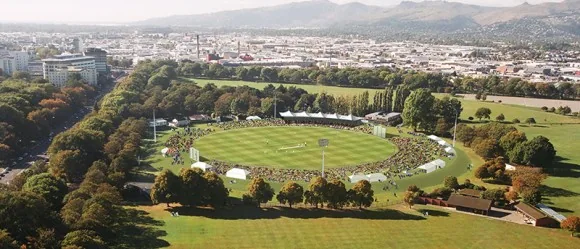
Hagley Oval is Christchurch’s international cricket ground in the heart of Hagley Park. It is a compact, grass-bank venue with a long Canterbury cricket history, but its modern international identity began with redevelopment after the 2011 earthquake. The ground hosted its first Test on 26 December 2014 and has since staged men’s Tests, ODIs and T20Is as well as major women’s internationals. This guide is checked to 22 October 2026 and keeps men’s Test, ODI and T20I records separate.
Key Takeaways - Hagley is not a one-word “seamer’s paradise”: new-ball pace, carry, swing and seam have been prominent in documented matches, while later Test sessions can become easier for batting. - The verified men’s records are format-specific: Test high 659/6 declared and low 95; ODI high 341 runs (341/7 and 341/9) and low 117; T20I high 236/4 and low 91. - The 22 October 2026 New Zealand–India T20I is a scheduled/current fixture at this cutoff, not an archived result and not part of the records above. - For a night match, use the toss with the actual surface, overheads and outfield condition. Hagley’s record does not justify an automatic “chase” rule.
Venue identity: where is Hagley Oval?
Hagley Oval sits at 57 Riccarton Avenue in central Christchurch, Ōtautahi, inside Hagley Park and beside the Botanic Gardens. ICC describes the first recorded match on the ground as Canterbury v Otago in 1867. The venue was rebuilt and approved after Lancaster Park ceased to be Christchurch’s main cricket home. NZC received ICC accreditation for the redeveloped ground in October 2014.
The setting is deliberately more open and park-like than a large stadium. The venue has one main permanent stand, grass embankments and the Hadlee Pavilion. The official Hagley Oval site says standard events can use up to about 12,000 spectators and major ICC events can expand towards 20,000; NZC’s 22 October 2026 notice gives an approximate 9,000-person capacity for that specific sold-out T20I. Those are event configurations, not a single universal capacity figure.
Six permanent floodlights were installed in 2020. They enabled broadcast-quality day-night cricket in Christchurch; the first official match under the lights was a domestic double-header in January 2021. The venue remains Canterbury’s home ground.
For the wider venue list, see the CricWin24 cricket grounds guide.
How does the Hagley Oval pitch play?
The safest description is pace-and-seam leaning, but condition-dependent. Evidence from the ground does support a lively new ball and useful carry. It does not support a permanent promise that every Hagley pitch will be green, fast or hostile to spin.
Ahead of the 2020 India Test, ESPNcricinfo reported a bright-green surface with roughly 12 mm of grass left on it. The report said the pitch was expected to offer more pace than Wellington, with seam movement likely to be strongest on days one and two and swing also possible. Trent Boult described Hagley as a place where the ball can swing and where the surface usually offers good pace and carry. The same report noted that Test spinners had, at that point, a poor average at the venue, while also warning that a skilled spinner could still influence a match.
NZC’s report from the 2016 Pakistan Test gives a more concrete example. It called the surface juicy and seam-friendly. Colin de Grandhomme returned 6/41 on debut as Pakistan were bowled out for 133, while NZC described the Pakistan attack as producing pace and bounce early. The toss and weather mattered too: persistent showers washed out the first day before New Zealand eventually won by eight wickets.
The surface can change during a long match. In the 2–6 December 2025 Test against West Indies, ESPNcricinfo described the pitch as increasingly docile under strong sun on the final day. West Indies faced 163.3 overs in the fourth innings and drew after Justin Greaves made 202 not out and Kemar Roach 58 not out. That is evidence against treating early movement as a permanent five-day rule.
Spin should therefore be judged by role and conditions rather than by a slogan. A spinner may be less valuable on a fresh, grass-covered pitch, but Nathan Lyon took three first-innings wickets in the 2016 Australia Test and Ish Sodhi took a wicket in the 2015 ODI. Batters who leave well and play late have a better chance after the new ball softens.
In T20Is, the evidence is wider-ranging. England made 236/4 in the 20 October 2025 night match, with Harry Brook scoring 78 from 35 balls and Phil Salt 85 from 56. New Zealand were then dismissed for 171 in 18 overs. Those numbers show that Hagley can support high-tempo batting under lights, but they do not erase the possibility of early movement: Rachin Ravindra fell to a hard new ball that moved enough off the deck in that same match.
Verified men’s Test records
NZC’s ground archive lists New Zealand’s 659/6 declared against Pakistan as the highest men’s Test innings at Hagley Oval. It was made from 3–6 January 2021. Kane Williamson scored 238, Henry Nicholls 157 and Daryl Mitchell 102 not out. New Zealand won by an innings and 176 runs after choosing to field first.
The lowest completed men’s Test innings is South Africa’s 95 all out against New Zealand, from 17 February 2022. Matt Henry took 7/23 and New Zealand won by an innings and 276 runs. This is a useful warning against importing the ground’s big totals into every forecast: the same venue can produce a collapse when the surface and new ball cooperate.
The highest individual men’s Test innings listed in NZC’s Hagley records is Tom Latham’s 252 against Bangladesh, scored on 9 January 2022. New Zealand made 521/6 declared in that innings and won by an innings and 117 runs. The recent standout is Justin Greaves’ 202 not out for West Indies on 6 December 2025, the anchor of a match-saving fourth-innings effort rather than a winning total. NZC and the full scorecard identify these as men’s Tests; they are not mixed with women’s Test records.
Representative Test matches worth remembering are the ground’s opening Test, New Zealand v Sri Lanka from 26–29 December 2014, and the 2025 West Indies draw. The first produced Brendon McCullum’s 195 from 134 balls in a New Zealand total of 441. The second shows the other side of Hagley: after early wickets, disciplined defence and a worn surface can make a fourth-innings rescue possible.
Verified men’s ODI records
The highest men’s ODI team score in the cited archive is 341 runs, shared by New Zealand’s 341/7 against Bangladesh on 26 December 2016 and Scotland’s 341/9 against Canada on 23 January 2014. Tom Latham made 137 and Colin Munro 87; New Zealand won by 77 runs. The archive orders New Zealand’s 341/7 above Scotland’s 341/9, but both innings have the same runs total; fewer wickets lost do not create a higher score.
The lowest completed men’s ODI innings is Sri Lanka’s 117 all out against New Zealand on 28 December 2015. Matt Henry took 4/33 and Mitchell McClenaghan 3/32; New Zealand chased 118 without losing a wicket, with Martin Guptill making 93 not out from 30 balls. The scorecard records short-ball bounce troubling Sri Lanka as well as the new-ball pressure, making this a match-specific example rather than proof that every ODI here is low-scoring.
For individual ODI context, NZC’s men’s archive lists Scotland’s Calum MacLeod at 175 against Canada on 23 January 2014 as the highest century entry at the ground. That World Cup Qualifier was the first ODI hosted at Hagley Oval’s redeveloped international venue. More recent evidence is New Zealand v West Indies on 16 November 2025, a day/night ODI in which Daryl Mitchell made 119 and New Zealand defended 269/7 by seven runs. West Indies won the toss and fielded, but the result was decided by a close 262/6 chase, not by a simple toss formula.
Verified men’s T20I records
The men’s T20I high is England’s 236/4 against New Zealand on 20 October 2025. Brook’s 78 from 35, Salt’s 85 from 56 and a 129-run third-wicket stand powered the record. New Zealand, who won the toss and fielded, were bowled out for 171 in 18 overs; Adil Rashid took 4/32. This is a completed night match and is the correct comparison for a high-scoring T20I, not a domestic T20 or women’s T20 record.
The men’s T20I low is Pakistan’s 91 all out against New Zealand on 16 March 2025. Pakistan were four down for 14 in the powerplay; Khushdil Shah’s 32 was their top score. Jacob Duffy took 4/14 and Kyle Jamieson 3/8, before New Zealand reached 92/1 in 10.1 overs. BBC Sport described it as Pakistan’s lowest T20 total in New Zealand, while NZC’s ground archive records 91 as the lowest completed men’s T20I innings at Hagley.
The spread between 91 and 236 is more informative than an invented “par score”. Powerplay wickets and the quality of the first 20 overs can dominate the venue label. The lights can reward clean hitting once batters are set, but a hard new ball still creates a route for pace bowlers.
The first New Zealand–India T20I listed for 22 October 2026 was scheduled at Hagley Oval for 8 pm and sold out, according to NZC. At this guide’s cutoff it was current rather than a completed archive result, so it is deliberately excluded from every record above. A fixture listing alone cannot establish a completed result.
Toss and match-planning guidance
In Tests, fielding first has been sensible when the surface is visibly fresh or grassed: New Zealand fielded first in the 2021 Pakistan high-total Test and the 2022 South Africa low-total Test, while Sri Lanka chose to field in the 2014 opener. That is a sample, not a guarantee. A captain should ask whether morning overheads and seam are worth using before the pitch settles.
For a day/night limited-overs match, inspect the live conditions. The 2025 ODI was played day/night and West Indies fielded first; the 2025 record T20I was a night game and New Zealand fielded first. Both choices produced different match shapes. If the ball is nipping and the outfield is heavy, bowling first can be logical. If the surface is dry, pace-off bowling is gripping and there is no obvious late moisture, batting first can be equally sound. Do not assume dew: confirm it from the evening conditions and the actual outfield.
For the 22 October 2026 New Zealand–India fixture, treat the toss as a final adjustment to the pitch reading. It should not override the verified record split or turn a scheduled match into a historical result. For a broader prediction framework, see the New Zealand v India match-prediction guide or the wider cricket match-prediction hub.
Frequently Asked Questions
Is Hagley Oval a batting or bowling pitch?
It can be both. Documented Tests show early pace, bounce, swing and seam, while the 2025 Test became more docile in the sun and the 2025 T20I produced 236/4. Call it pace-and-seam leaning when the surface is fresh, not permanently bowler-friendly.
What is the highest Test score at Hagley Oval?
New Zealand’s 659/6 declared against Pakistan from 3–6 January 2021 is the highest verified men’s Test innings in NZC’s ground archive.
What is the lowest T20I score at Hagley Oval?
Pakistan’s 91 all out against New Zealand on 16 March 2025 is the lowest verified men’s T20I innings. New Zealand won by nine wickets.
Who made the highest individual Test score at Hagley Oval?
Tom Latham made 252 against Bangladesh on 9 January 2022, the highest men’s Test innings listed in the NZC Hagley records. Justin Greaves’ 202 not out in December 2025 is a major recent performance but not the overall high.
Was New Zealand v India on 22 October 2026 a completed Hagley record?
Not at the cutoff used here. NZC listed it as a scheduled, sold-out T20I, and current/live fixture information is not the same as a completed scorecard. A completed record requires a final, verified result.
Takeaway
Hagley Oval rewards a specific reading of the day rather than a fixed pitch cliché. The strongest evidence is a fresh surface that can give seamers pace, carry and movement, followed by batting conditions that may improve as the match progresses. Use the separate Test, ODI and T20I records, check whether the sample is men’s or women’s cricket, and treat toss guidance as conditional. That approach captures Hagley’s real range: from 95 all out and 91 in completed men’s internationals to 659/6 declared and 236/4.